Scaling Campus Cooling in Style at Wake Forest
Key Highlights
- Design focused on minimizing campus disruption by building upward rather than outward, preserving existing space and aesthetics;
- The project achieved significant energy savings through variable speed chillers and optimized control systems, with further savings anticipated in off-peak seasons;
- The South Chiller Plant was expanded vertically by placing new chillers and towers on a custom steel superstructure to optimize space;
- Two 600-ton chillers were replaced with two 1,200-ton units, increasing total capacity from 3,600 to 4,800 tons, supporting campus growth;
- Electrical systems were upgraded with larger transformers and switchgear, ensuring reliable power supply and emergency operation during outages.
By CHASE DAVIS, PE, CEM, Mechanical Engineer, Project Manager, RMF Engineering
Located in Winston-Salem NC, Wake Forest University (WFU) experiences a temperate climate with four distinct seasons, requiring energy and HVAC capabilities adjustable to a variety of conditions to serve the over 9,000 students and faculty housed on campus.
As the University grew and those needs evolved, RMF Engineering was engaged to upgrade the campus’ South Chiller Plant, which operates as part of its robust district chilled water system alongside the 2,400-ton-capacity North Plant, which was renovated in 2019.
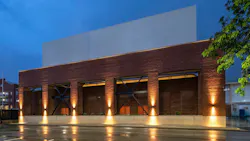
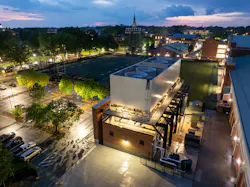
While upgrading the campus systems, a primary goal was to minimize disruption to campus life and programming as much as possible. To navigate this priority, the new construction was built up rather than out, utilizing existing square footage by placing the new chillers on top of the existing plant. This strategic approach minimized the required real estate for the project while expanding cooling capacity, creating essential resiliency efficiency improvements to WFU’s main campus.
Chilled Water for a Growing Campus
WFU began its initiative to optimize chilled water systems in 2015, with the South Plant expansion marking a significant milestone in this undertaking. This latest advancement signifies the successful upgrade and optimization of the entirety of its chilled water generation system, a decade in the making.
The South Plant’s existing controls became limited in performance due to the aging equipment, requiring the careful evaluation and replacement of these pieces to bring it back to peak performance. The expansion comprises four new custom towers, condenser water pumps, and piping, as well as the replacement of two 600-ton chillers with two 1,200-ton chillers, operating alongside two other existing 1,200-ton chillers. This effort increased the plant's capacity by 33% from 3,600 to 4,800 total tons, further enhancing its operational capacity to meet the changing needs of the campus population.
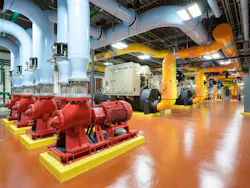
A critical component of the process was engaging WFU’s primary chiller plant operator from the onset. This relationship provided a firsthand operations perspective that influenced the design for the better, creating a result that met both the needs of the university as well as those who will operate and maintain the equipment day-to-day. These professionals have the ability to think ahead, understanding what’s plausible for application, maintenance, and evolution and, in turn, promoting the longevity and efficiency of operations.
Electrical Design Fit for Any Occasion
In conjunction with these upgrades to chilled water, the project also encompassed the redesign of the entire plant power feed. The South Plant is the larger of the two plants located on WFU’s campus, underscoring its importance especially during peak summertime electric and cooling times; the North Plant features 2,400 tons, but can only carry the campus for about half the year.
Due to the South Plant’s relocation and capacity increase, the medium voltage switch and transformers needed to be upsized to accommodate this change. The team was challenged by the locations of the footings for the large superstructure columns in the path of the existing duct bank to the plant, requiring the medium voltage rework be the first phase of the project. The new pad mounted switch and two 2,500 kVA transformers were the first items to be procured and installed as a result.
Emergency contingency planning was front-of-mind throughout the engineering design of the project, especially given the scale of operations and sheer amount of people relying on the safety and dependability of the system. The plant is strategically designed to be at least partially operational in the event that one of its two 2,500 kVA transformers goes offline, maintaining 2,400 tons of cooling to the campus. This purposeful approach ensures that the proper infrastructure is in place to cause little to no interruption to service under a variety of conditions.
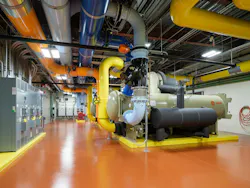
Optimizing Operations Within a Constrictive Footprint
As mentioned, the project implemented an innovative design solution by building vertically to maximize the potential of the allotted square footage while minimizing interruptions caused to the campus during construction—which wasn’t originally a part of the plan.
Due in part to the plant's location, a feasibility study concluded that designing the towers to sit on a new steel superstructure spanning over the existing plant was the best path forward. This configuration addressed WFU’s operational needs and also provided added benefits in real estate savings and aesthetics.
The superstructure is sheathed in brick to blend in with nearby buildings, a result of the close collaboration between RMF and Michael Graves, who served as the architect for the project. The vertical tower seamlessly blends into the aesthetic language of the campus through an architecturally driven approach to sightlines and materiality. The team used fiberglass reinforced polymer (FRP) to enable the selection of custom colors, creating a precise match to the adjacent building.
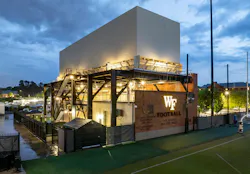
Structural coordination posed a significant challenge to the project, as constructing a sizable steel superstructure around and over the building in coordination with the cooling towers required a carefully balanced approach. Though the engineering of the project largely focused on mechanical-electrical, considerable structural planning was implemented from the inception of the design through construction.
Large columns facing outward to campus had to be symmetrical and aligned with the key tower load point and equipment access paths, while 40-in-deep horizontal beams needed to be high enough to allow access to large piping hidden from view under the tower. They also had to avoid a noticeable gap between the existing building and new structure. RMF’s in-house structural engineering team worked with Graves to incorporate the look into the design when cross bracing was needed between the columns, which added even more character to the building.
Setting the Stage for Long-Term Success
By autumn of 2025, the incorporation of the new variable speed chillers, variable flow condenser water, and custom towers had yielded reductions during peak summer operations amounting to 0.2 kW/ton, well over $100K every year in savings. Further reductions are anticipated as the plant’s variable speed equipment enables further optimization through the off-peak seasons.
The mechanical and electrical expansion of WFU’s South Chiller Plant emphasizes the importance of advanced planning and collaboration between engineering teams and all other project partners, from architects and designers to university operations personnel. Throughout each phase of the project, the highly integrated team remained rooted in WFU’s commitment to resilience, efficiency and positive campus impact.
With an enhanced understanding of each component’s impact and operations, the project efficiently meets the requirements of campus aesthetics, power, and maintenance. This nuanced strategy facilitates not only its successful execution, but its longevity as a reliable resource well into the future.
About the author
Based in Raleigh NC, Chase Davis, PE, CEM, is a Mechanical Engineer and Project Manager at RMF Engineering based. As part of RMF’s utility infrastructure group, his experience includes the analysis, design and construction administration of steam, heating water, chilled water and emergency power generation systems in various campus environments. He has provided services for university, healthcare, industrial and municipal clients.