Construction Hiring, Spending Fell as Material Prices Climbed to Start Year
Key Highlights
- Construction employment decreased by 11,000 jobs in February, but is still 0.5% higher than a year ago;
- Nonresidential construction spending fell 0.6% in December, driven mainly by declines in manufacturing and private sector segments;
- Construction input prices increased by 0.7% in January, with tariffs and energy prices impacting material costs;
- The industry outlook remains cautious, especially now that war in the Middle East is disrupting world trade.

WASHINGTON, March 6 — The U.S. construction industry lost 11,000 jobs on net in February, according to an Associated Builders and Contractors (ABC) analysis of data released Friday by the U.S. Bureau of Labor Statistics (BLS). On a year-over-year basis, industry employment has still grown by 42,000 jobs, an increase of 0.5%.
Nonresidential construction employment decreased by 3,800 positions, with losses in 2 of the 3 subcategories. Heavy and civil engineering lost 6,500 jobs and nonresidential specialty trades lost 1,400 positions, while nonresidential building added 4,100 jobs in February.
The construction unemployment rate was 6.9% in February. Unemployment across all industries rose to 4.4% and is 0.2 percentage points higher than one year ago.
“Construction employment shrank again in February and has now declined in 8 of the past 11 months,” said ABC Chief Economist Anirban Basu. “Both the residential and nonresidential segments lost jobs for the month, adding to a recent string of downbeat industry data releases; construction spending has been in decline for several quarters, and ABC’s Construction Backlog Indicator fell to a four-year low in January."
Added Basu, "With the conflict in Iran adding to trade policy-related uncertainty and crude oil prices now well above $80 per barrel, our industry’s overall outlook remains downbeat through the first few months of 2026.”

Nonresidential Construction Spending Down Sharply
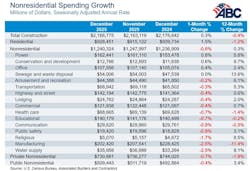
On February 27, the U.S. Census Bureau released data on nonresidential construction spending for December, which decreased 0.6% for the month. On a seasonally adjusted annualized basis, nonresidential spending totaled $1.24 trillion.
Spending was down on a monthly basis in 12 of the 16 nonresidential subcategories. Private nonresidential spending was down 0.7%, while public nonresidential construction spending was down 0.4% in December.
“Nonresidential construction spending contracted sharply in December,” said Basu. “This decline was concentrated in the manufacturing segment, which is now down nearly 16% from the August 2024 all-time high. Given trade policy uncertainty and the waning effects of the CHIPS Act, manufacturing-related spending will likely continue to decline over the next several quarters...
“While manufacturing is the most significant driver of nonresidential weakness, it’s far from the only one,” said Basu. “Eight of the 11 private nonresidential subsegments contracted in December, and total private nonresidential spending is now down 1.8% year over year. Given this weakness, it is unsurprising that ABC’s Construction Backlog Indicator fell to a four-year low in January.”

Materials Prices On Rise
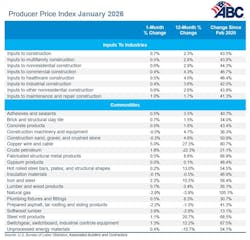
In January, construction input prices also nudged upward by 0.7%, compared to the previous month, according to an ABC analysis of the BLS Producer Price Index (PPI) data also released February 27. Nonresidential input prices increased 0.6% for the month.
Overall, construction input prices are 2.3% higher than a year ago, while nonresidential construction input prices are 2.9% higher. Prices increased in 2 of 3 energy categories in January. Crude petroleum and unprocessed energy materials prices were up 1.8% and 0.4%, respectively, while natural gas prices were down 2.9% for the month.
“Nonresidential construction input prices rebounded in January, surging at a blistering 7.1% annualized rate for the month,” said the ABC Chief Economist. “While this sharp monthly rise can be traced to significant increases in prices for tariff-affected products like copper wire and cable, iron and steel, and industrial controls equipment, aggregate input price escalation is not particularly concerning right now. Nonresidential materials prices are up just 2.9% over the past year and have been virtually flat over the past several months, rising just 0.2% since September despite some large monthly fluctuations.
“Trade policy may continue to put upward pressure on certain input prices, especially those subject to the large Section 232 tariffs,” he added. “Even so, input escalation is unlikely to rise too sharply as long as energy prices remain tame and demand remains subdued. Contractor sentiment seems to reflect this; optimism regarding profit margins improved in January, according to ABC’s Construction Confidence Index, although it remains lower than one year ago,” noted Basu.