NFPA Backs 'Pro Codes Act' to Preserve Standards Copyright Protection
Key Highlights
- The Pro Codes Act aims to protect copyright rights of standards incorporated into laws, ensuring ongoing funding for safety initiatives;
- Funding from licensing and sales of standards is crucial for NFPA to develop new standards for emerging risks;
- Legislation enjoys bipartisan support, with key figures emphasizing its importance for public safety;
- Weakening copyright protections could jeopardize the development and updating of vital safety standards, risking public safety.
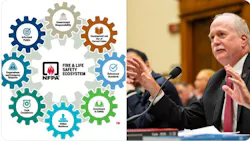
Washington DC, April 22, 2026 — The National Fire Protection Association® (NFPA®), a self-funded nonprofit that develops over 300 fire, life, and electrical safety standards, praised the U.S. House Judiciary Subcommittee on Courts, Intellectual Property, Artificial Intelligence, and the Internet, for holding a hearing this week on the bipartisan Protecting and Enhancing Public Access to Codes (Pro Codes) Act (H.R. 4072).
NFPA President and CEO Jim Pauley testified before the Subcommittee in support of the legislation.
"Every year, the standards developed by NFPA and organizations like us prevent tragedies that no one will ever hear about — the fires that don't start, the buildings that don't collapse, the families that come home safe," said Pauley in his testimony. "That's what this system produces. And that's what we stand to lose if Congress doesn't act."
Pauley also spoke to the urgency of the issue: "The need for this system is not diminishing — it's accelerating. From devastating wildfires to new risks from lithium-ion batteries, NFPA is developing standards to address challenges that didn't exist a decade ago. But that work only continues if it can be funded. And if copyright protection is weakened or lost, the funding disappears — and with it, the system that has made Americans safer for more than a century."
The House bill was introduced by Subcommittee Chairman Darrell Issa (R-CA) and Rep. Deborah Ross (D-NC). In March, a Senate version (S. 4145) was introduced by Senators Chris Coons (D-DE), John Cornyn (R-TX), Thom Tillis (R-NC), and Mazie Hirono (D-HI).
"We’re grateful to Chairman Issa and Ranking Member Johnson for this hearing, which confirmed the urgent need for the bipartisan Pro Codes Act. And we want to thank Chairman Issa and Rep. Ross for their tireless efforts to preserve the extraordinary public-private partnerships that have protected Americans for more than a century," said Pauley. “During the hearing we made clear why Pro Codes is needed, and we look forward to its consideration by the full committee.”
Pauley’s full testimony can be found here.
Issue Summary
For nearly 130 years, safety standards developed by independent nonprofit organizations like NFPA have protected people and property. These safety standards have dramatically reduced dangers like fire incidents and deaths and helped our communities better prepare for threats like active shooters.
Independently developed standards are so valuable that government entities often choose to incorporate them by reference into laws and regulations. This is a clear public benefit. In fact, for decades, the federal government has directed federal entities to use voluntary consensus standards whenever possible to eliminate costs to government, improve efficiency, and promote long-term growth for U.S. enterprises.
But this time-tested system is under threat from special interests and for-profit companies who wrongly argue that standards incorporated by reference into laws forfeit their copyright protection. Copyright protection incentivizes innovation and supports standards development organizations, helping ensure the United States remains the world leader in safety.
NFPA and other standards development organizations fund their work by publishing, selling, and licensing copyrighted standards to professionals who use them in the course of their business and licensees who make software and other business solutions that incorporate those standards.
Foreign actors and for-profit businesses that did nothing to contribute to the creation of standards are trying to profit by exploiting them. The result is that standards development organizations lose their funding sources from legitimate professionals and businesses – which means there are not funds to invest in updated standards, or the educational and research efforts they support.
The Pro Codes Act reaffirms that standards maintain their copyright protection when governments incorporate them by reference into laws and regulations. It also encourages greater transparency for the public, while protecting the ability of groups like NFPA to continue their important work. For more information about the Pro Codes Act, visit DontChanceSafety.org.
To easily contact your senators and representatives to urge them to cosponsor the legislation, visit this website.