Designing Commercial Heat Pumps for Greater Performance
Key Highlights
- Heat pump systems require careful evaluation of operational limits, hydraulics, and control sequences to ensure reliable performance;
- Hydraulic decoupling and dedicated pumping are essential for stabilizing flow and preventing equipment lockouts and outages;
- Relocating bypass valves and increasing active system volume improve thermal stability and reduce cycling in heat pump applications;
- Design principles such as thermal buffering and minimum-flow protection help maintain system efficiency during variable load conditions;
- Early integration of hydraulics and controls is crucial for the success of electrified, decarbonized HVAC systems in commercial buildings.
By VINAY SHEKAR, PE, LEED AP, and ROBBY OYLEAR, PE, LEED AP, Affiliated Engineers, Inc.
Increasing demand for building electrification and decarbonization has accelerated the adoption of heat pump technologies in commercial HVAC systems. These systems offer significant energy and carbon reduction benefits through high-efficiency heating, cooling, and heat recovery.
However, unlike traditional hydronic systems, heat pump plants require a more thorough evaluation of operational limits, system hydraulics, and control sequences.
This case study of an all-electric thermal plant with domestic water heat pumps (DWHP), air-to-water heat pumps (AWHP), and water-to-water heat pumps (WWHP) illustrates some common challenges of heat pump systems and highlights key design strategies for reliable performance.
All-Electric Building Design – Operational Challenges
Shortly after occupancy, operators at a laboratory building began experiencing recurring equipment lockouts, low-temperature and low-flow alarms, and heat pump outages. The initial assumption was that the heat pumps were operating outside their allowable temperature range.
However, an investigation revealed that the underlying issues were more complex—and rooted in the building’s central plant system design and operational setup.
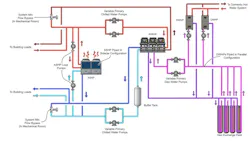
The facility evaluated in this case study uses an all-electric heating and cooling plant comprising a central geo-exchange bore, field-connected to a six-pipe WWHP and DWHP with supplemental heating/cooling provided by an AWHP (Figure A). The WWHP operates in heating, cooling, or heat recovery mode. The common geo-exchange source loop supports both WWHP and DWHP, while simultaneously serving space conditioning loads, with an AWHP sized to provide supplemental cooling during peak load conditions and heating during the shoulder season.
From a thermal capacity standpoint, the system was appropriately sized based on anticipated building loads, operating conditions, and corresponding equipment performance under those conditions. The operational problems, however, exposed the importance of heat pump flow stability requirements and the hydronic loop arrangement.
Figure A: Design Plant Configuration
Heat Pump Flow Stability and Lift
The first operational concern involved the DWHPs. Operators reported recurring low-flow alarms and intermittent domestic hot water outages. Because source-water temperatures were relatively low during the winter, it was initially thought that the entering water temperatures were below equipment operating limits.
However, the manufacturer's specifications confirmed that the heat pumps could operate at temperatures lower than those observed on site.
Further investigation identified unstable source-water flow as the primary cause of the shutdowns. The DWHPs relied on small source-water pumps connected in parallel to the same variable-flow, geo-exchange loop serving the rest of the plant. As the larger primary geo-exchange circulation pumps modulated, system differential pressure increased. The smaller DWHP pumps were unable to consistently overcome this pressure and maintain their required design flow.
Although the entering water temperatures remained within the allowable operating range, inadequate flow resulted in repeated equipment trips and domestic hot water interruptions.
The investigation also revealed that the units were operating under exceptionally high compressor lift (condenser-leaving water temperature minus evaporator-leaving water temperature), resulting in reduced system efficiency. The heat pumps were required to produce domestic hot water temperatures of 130°F to 140°F while extracting heat from a geo-exchange loop that could operate near freezing during winter conditions. This required the compressors to overcome a temperature lift exceeding 100°F, placing the equipment near the upper end of its operating range.
This highlights an important design principle for heat pump systems.
Unlike traditional combustion or electric boilers, heat pumps are significantly less tolerant of fluctuating flow conditions and must operate within the manufacturer’s allowable range. Even when operating within the manufacturer's allowable temperature range, insufficient flow can quickly trigger low-pressure, freeze-protection, or compressor performance issues, as well as safety shutdowns.
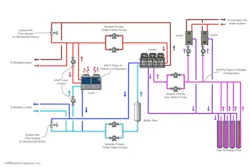
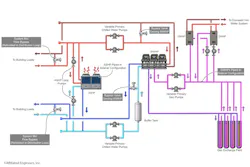
The primary solution was to hydraulically decouple the DWHPs from the main geo-exchange loop using a sidecar arrangement (Figure B). This helped stabilize flow and isolate the heat pump from pressure fluctuations occurring elsewhere in the system.
Additionally, an auxiliary electric heating system with a swing/buffer tank system was recommended to maintain a lower compressor lift and provide stable high-temperature water on the distribution side of the system.
Figure B: Modified Plant Configuration.
Heat Pump Hydronic Loop Arrangement
The second operational concern involved the WWHP. During periods of near-peak heating demand with simultaneous lower cooling loads, the WWHP experienced unstable flow conditions, resulting in alarms, inconsistent operation, and periodic unit shutdowns.
Our investigation determined that the system's minimum-flow bypass valve was located immediately adjacent to the heat pump equipment, like a traditional variable-flow boiler or chiller plant.
During low-cooling-load conditions, this arrangement created a short hydraulic loop that reduced the active system volume available to the heat pump, decreased thermal stability, and increased susceptibility to rapid temperature fluctuations and cycling.
Relocating the bypass valves farther downstream within the distribution system (Figure B) increased the active system volume and promoted flow through a larger portion of the hydronic network. This modification allowed for a longer cycle time before supply water returned to the heat pump via the bypass under low-load conditions, increasing equipment runtime and part-load performance.
This reinforces an important design principle for heat pump systems: stable, reliable performance ultimately requires understanding the effective thermal volume available to the heat pump under different operating conditions.
Practical experience from similar modular heat pump installations has also demonstrated that variable-primary hydronic systems require careful flow controls. Modular heat pumps utilize on-board controls to stage compressors and vary internal flow paths, making variable-primary pumping difficult since the system flow required by the current load becomes dependent on the equipment’s flow requirements.
The building automation system (BAS) must balance stable minimum flow and differential pressure at the modular heat pump against the flow requirements of the building loads, with limited visibility and control over the internal heat pump operation.
For these reasons, primary-secondary hydronic configurations are the preferred system arrangement for modular heat pump applications. By hydraulically decoupling equipment flow from distribution flow and utilizing dedicated pumping, primary-secondary systems provide more stable flow conditions, simplify control sequences, and improve overall system reliability.
Reliable Performance Starts with Integrated Design
This case study demonstrates that the success of heat pump plants depends as much on hydraulics and control sequences as it does on equipment selection. As more buildings move toward electrification, engineers must ensure they are as focused on operational equipment tolerances as they are on equipment schedules and capacity calculations.
Dedicated pumping, hydraulic decoupling, minimum-flow protection, thermal buffering, and carefully coordinated controls are often the factors that determine whether a heat pump plant operates reliably. When these principles are incorporated early and refined as design progresses, heat pump systems can provide efficient, resilient performance across the full range of operating conditions.
About the Authors
Vinay Shekar, PE, LEED AP®, is a project engineer at Affiliated Engineers, Inc., with over 10 years of experience providing HVAC, mechanical design, and energy analysis for complex healthcare, laboratory, biotechnical manufacturing, and commercial building projects.
Robby Oylear, PE, LEED AP®, is a principal at Affiliated Engineers, Inc., with over 19 years of experience delivering solutions for complex mechanical systems, central utility plants, and infrastructure across corporate, healthcare, and research facilities.