Smoke Signals: How Duct Liner Choice Impacts Fire Safety
Key Highlights
- Fire safety in HVAC systems is crucial, with codes requiring materials to meet specific fire and smoke performance standards;
- ASTM E84 and UL 181 are key tests used to classify duct materials based on flame spread and smoke development indices;
- Most building codes mandate at least Class 1 (UL Class 1) duct materials, ensuring minimal contribution to fire spread and smoke production;
- Recent studies, such as NAIMA's 2023 report, highlight potential failures of elastomeric duct liners to meet claimed fire performance standards;
- Building professionals should request third-party ASTM E84 test reports for duct materials and reevaluate product specifications to ensure safety.
By DAVID A. BURD, Technical Leader, Air Distribution, Owens Corning Technical Services
Have you ever sat around a campfire and found yourself moving from one spot to another to avoid the smoke blowing in your face? Most of us have, and we do this because the smoke irritates and even hurts our eyes, noses and throats, making breathing, or even seeing, difficult.
According to the National Fire Protection Association (NFPA):
Most fire deaths are not caused by burns, but by smoke inhalation. Often, smoke incapacitates so quickly that people are overcome and can’t make it to an otherwise accessible exit. The synthetic materials commonplace in today’s homes produce especially dangerous substances. As fire grows inside a building, it will often consume most of the oxygen, slowing the burning process. This incomplete combustion results in toxic gases.1
Fire and smoke performance are critical factors to consider when designing building systems and selecting building materials. The HVAC system is no exception. There are codes in place to help protect building occupants. Codes include fire-rated wall assemblies, NFPA 13 for Sprinkler Systems, NFPA 14 for Standpipes and Hose Systems and NFPA 72 for Fire Alarm and Signaling Systems.
Codes also restrict what systems or materials can penetrate through a fire-rated assembly, such as a fire wall, which includes duct systems. In most cases, the fire-rated penetrations of duct systems require fire dampers or other methods such as firestops, which can be used if appropriate to the application.
Today, there are several materials used to make an air duct, including fiberboard, composite, sheet metal, fiberglass, PVC and gypsum board, among others. Cost, fire/smoke performance, ease of installation and material availability may all affect how a duct material is selected. For many reasons, sheet metal is commonly used to create an air duct in a commercial building.
A duct system’s primary job is to deliver conditioned air from the Air Handling Unit (AHU) to occupied spaces. Additional considerations that can guide duct system design are how efficiently and quietly conditioned air gets delivered. One factor that must always be addressed is fire safety. A duct liner, like other building systems and materials, must meet fire and smoke performance criteria even though it is inside a sheet metal duct.
Thankfully, because of the due diligence of the fire community and code bodies, fire risk in buildings has been reduced when compared to buildings of yesteryear. Measures to mitigate this risk include the requirement that building materials be tested to ASTM E84 or UL 723 Standard Test Method for Surface Burning Characteristics of Building Materials and meet specific criteria before being used in a building. If you want to learn more about ASTM E84 or UL 723, I highly encourage you to look into this quite interesting test.
Two results obtained from the ASTM E84/UL 723 testing, Flame Spread Index (FSI) and Smoke Developed Index (SDI), are used to assess the surface burning characteristics of a material. Duct materials are classified by the Underwriter’s Laboratory (UL) per UL 181 Standard for Safety as Class 1.
NFPA uses the Class A duct classification, which is the same as a UL Class 1. A UL Class 1 air duct has an FSI not greater than 25 and an SDI not greater than 50. So, what does that mean? FSI is a number that expresses how fast and far a flame spreads during a 10-minute test. This number indicates the relative rate at which a flame will spread over the surface of a material when compared with the flame spread of cement board, which is rated 0, and on red oak, which is rated 100.
It is important to remember that FSI is not the rate at which the flame spreads along the surface, but is an index. The higher the number, the further and/or faster the flame advances on the material's surface. During the same 10-minute test, the amount of smoke generated is measured.
The SDI relates to the optical density of smoke produced under the standard test conditions. Again, the higher the number, the more smoke there is.
The majority of codes, including NFPA 90A: Standard for the Installation of Air Conditioning and Ventilating Systems and NFPA 90B: The Standard for the Installation of Warm Air Heating and Air Conditioning Systems, require at least a Class 1 air duct as tested per ANSI/UL 181 – Standard for Safety Factory-Made Air Ducts and Air Connectors. Manufacturers do a substantial amount of testing to ensure the safety of their products. Third-party organizations also conduct test studies to verify the performance of these materials.
NAIMA (North American Insulation Manufacturers Association) released results from a study on fiberglass and elastomeric duct liners in 2023. The NAIMA publication, AH149 5/23 Fire Performance of Duct Liners: A Product Comparison Study, is available at the Insulation Institute’s website, https://insulationinstitute.org/, and can also be accessed by typing the study title into a search engine. As the study found:
Initial testing performed by NAIMA at independent testing laboratories showed consistent failure of elastomeric products to meet claimed FSI and SDI performance from multiple manufacturers. NAIMA engaged with multiple elastomeric product manufacturers to provide substantiation of their claimed performance (i.e., independent ASTM E84 test reports) – no manufacturer provided a report.2
The result of this initial testing prompted the launch of a formalized Round Robin Test Plan, of which the details are provided within the study. The results of the Round Robin testing by product class are provided here:
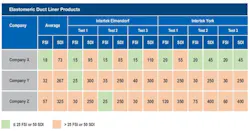
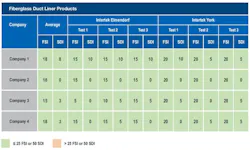
When a building is on fire, smoke fills the building, seeking the most minor paths of resistance, including the air ducts and plenums. What we don’t want to happen is to have the duct liner itself contributing to the amount of smoke developed. So, what can those working in the professional building space do?
Building professionals such as designers, specifiers, project managers or building managers can request a third-party ASTM E84 test report for the materials or products cited in their job specifications and reevaluate those products. As NAIMA says in its study, “If you have standard specifications for elastomeric duct liner products, it may be worthwhile to call out specific products that you have obtained ASTM E84 reports for or remove elastomeric from the standard specification until more information is provided.”2
#####
1 NFPA Article “Reporter’s Guide: The Consequences of Fire” https://www.nfpa.org/about-nfpa/press-room/reporters-guide-to-fire/consequences-of-fire
2 Fire Performance of Duct Liners: A Product Comparison Study, NAIMA Pub. No. AH149 5/23