Plasmonic Photonic Technology Offers New Path to Indoor Air Purification
Key Highlights
- Traditional air filters like HEPA and UV-C have limitations in effectively removing all viruses, VOCs, and biological contaminants;
- PECO technology, developed by Dr. Goswami, significantly improved indoor air purification by targeting both biological and molecular pollutants, and was widely adopted during the pandemic;
- The latest plasmonic photonic technology utilizes nanoparticles and UV-A light to achieve higher efficiency in neutralizing viruses, bacteria, mold spores, and VOCs, with FDA 510(K) clearance.
- Extensive testing in controlled chambers demonstrated elevated performance of plasmonic photonic systems, with reaction rate constants indicating a 60.7% improvement over previous formulations.

By D. Yogi Goswami, PhD, PE, Distinguished Professor, Director, TECO Clean Energy Research Center, University of South Florida
It's no secret. Air quality has long been declining worldwide due to emissions from power plants, automobiles, industrial activities, etc. In addition, organic compounds emissions from indoor building materials, carpets, paints, and surface finishes also contribute significantly to indoor air pollution globally.
Scientists researching the emergence of viruses due to climate change and the World Health Organization (WHO) continue to warn us about new viruses for which we may not have protection. In addition, COVID-19 and other recent airborne viruses and their mutations have further highlighted the global impact of air quality and the risks associated with airborne transmission.
Among the pollutants of greatest concern in indoor environments are biological contaminants—such as viruses, bacteria, mold, and fungal spores—as well as volatile organic compounds (VOCs) and allergens including dust mite and cockroach droppings. These pollutants not only cause illness, but are also major contributors to allergies and asthma affecting a large portion of the global population.
Historically, air-cleaning technologies have focused primarily on removing particulate matter, with High Efficiency Particulate Air (HEPA) filters considered the most effective option. However, HEPA filters cannot efficiently filter all viruses and VOCs.
Additionally, bacteria and mold spores trapped within the filters can proliferate if the filters are not replaced regularly. UV-C technology has gained popularity in large buildings for air disinfection, but its 95% kill rate of UV-C is not sufficient because the remaining viruses and bacteria multiply very quickly, and direct exposure to UV-C can be hazardous and may generate ozone, which is hazardous even at low concentrations.
More recently, air ionization technologies have been introduced into the market. However, according to studies from the U.S. Environmental Protection Agency and others, ionic technologies also have several hazards associated with them, such as increased Ozone production, more VOCs, and other health problems.
To address the limitations of traditional air filtration technologies, I developed the Photocatalytic Oxidation (PCO) in the early 1990s to help my son, who suffered from asthma and allergies due to pollutants in indoor air.
Today, some major HVAC manufacturers are still marketing the PCO technology. However, over the years, I noticed that the PCO technology had a low quantum efficiency because of electron-hole recombination.
To address this limitation, I developed the next generation Photo Electro-Chemical Oxidation (PECO) technology, which achieves much faster destruction of indoor air pollutants. These methods improve air purification by targeting both biological pollutants—such as bacteria, viruses, and spores—and molecular contaminants like VOCs, while also filtering dust particles.
PECO was commercialized as Molekule Inc., which introduced portable air purifiers that achieved US FDA 510(K) clearance, and helped millions of health care workers and other at-risk populations during the COVID-19 pandemic.
More recently, a next generation Plasmonic Photonic Technology has been developed for disinfection and detoxification of indoor air.
This advanced approach represents a significant step forward in indoor air purification and offers protection against future pandemics as well as a wide range of indoor pollutants. The technology utilizes the addition of plasmonic nanoparticles in the photocatalyst that interact with UV-A light, producing resonant effects that amplify the absorption of incoming photons and enhance their effectiveness.
As a result, this process achieves higher efficiency than existing photonic purification technologies. Extensive testing has demonstrated the capability of plasmonic photonic systems to effectively neutralize viruses, bacteria, mold, fungal spores, and VOCs.
Performance of Plasmonic Photonic technology against viruses, bacteria and fungal spores
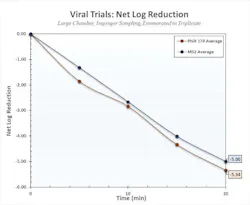
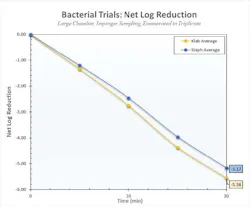
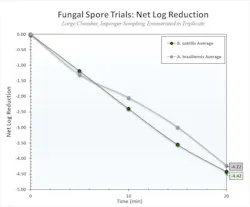
Tests were conducted at the Aerosol Research and Engineering (ARE) Labs to study the performance of the Plasmonic Photonic technology against aerosolized ssRNA virus, ssDNA virus, Gram-negative bacteria, gram-positive bacteria, bacteria endospores, and mold spores, and were submitted to US FDA by Applied Photonix, the company commercializing this technology. Applied Photonix received FDA 510(K) clearance based on these results.
Experimental Set-Up:
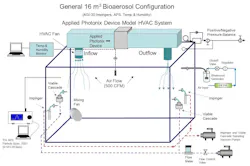
Experiments were conducted in a large, sealed aerosol chamber to simulate a contaminated room. The test chamber's internal dimensions are 9.1-ft x 9.1-ft x 7-ft, with a displacement volume of 579 cubic feet, or 16,000 liters. These images show both a schematic and a picture of the chamber.

Experimental Investigation of Performance against VOC’s:
Experiments were conducted in an environmental chamber to demonstrate the improvement of the present technology described herein for the destruction of volatile organic chemicals (VOCs).
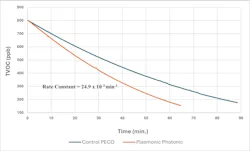
Tests were conducted for the destruction of Toluene, an organic compound difficult to oxidize and destroy. Two catalytic formulations were used, including a Control Basic PECO and a Plasmonic Photonic, with all the other conditions being the same. The incident light was UV-A and Visible with a wavelength range of 350 – 420 nm. This wavelength range is the same as sunlight, therefore safe for humans.
Performance of the Plasmonic Photonic Technology
All of the tests for the destruction of VOCs were conducted at the USF Clean Energy Research Center in Tampa FL. Each catalytic formulation was tested at least 20 times. Each time the performance was consistent. The results of all the experiments with these formulations are presented below. These plots in Figure 3 are composites of all the trials for these formulations. The error bars have been removed in this presentation to understand the overall improvement for each of these formulations. Reaction rate constants were calculated for each of these formulations and compared.
The calculated reaction rate constants for these formulations are:
Control Basic PECO = 15.5x10⁻³min-1, Plasmonic Photonic = 24.9x10⁻³min-1.
Therefore, the improvement of the Plasmonic Photonic over the control is 60.7%.
Conclusion
We have invented an advanced new plasmonic photonic technology for disinfection and purification of indoor air. Applied Photonix LLC has developed products based on this technology that integrate with the central air conditioning systems of buildings. The products based on the new technology were tested at ARE Labs, which led to the FDA 510(K) clearances for them.
For more information, visit https://www.aphotonix.com.
About the author
A Fellow at the National Academy of Inventors and member of the Florida Inventors Hall of Fame, Dr. Goswami holds a PhD in Mechanical Engineering from Auburn University. He joined the engineering faculty at University of South Florida in 2005 and is currently president of the Academy of Science, Engineering and Medicine of Florida (ASEMFL).