Engineering MEP Systems for Tornado Shelters
Key Highlights
- Proper equipment mounting outside the shelter must meet wind load requirements, with internal placement preferred to reduce structural complexity and debris risk;
- Penetration protection involves tested assemblies for large openings, with piping protected by steel shrouds and ductwork using FEMA-rated louvers to minimize wind and debris damage;
- Ventilation can be natural or mechanical; design must consider tornado season, atmospheric conditions, and operational needs, ensuring adequate airflow during storm events;
- Emergency cooling and HVAC systems should be located within the shelter when continuous operation is necessary, with protective measures for heat rejection components against debris and wind loads;
- Electrical systems require backup power for lighting, ventilation, and water, with generator enclosures rated for storm conditions and considerations for long-term reliability.
By RICHARD LONG, PE, and ALEKSANDAR MILENKOV, PE, LEED AP, KAI Engineering
The careful integration of mechanical, electrical, and plumbing (MEP) systems is essential to the reliable performance of any storm shelter. The 2023 ANSI/ICC 500/NSSA Standard establishes the design criteria for various shelter types and their intended uses.
This article presents several design strategies informed by KAI Enterprises’s experience developing community storm shelters intended for tornado protection. As with any project, designers should consult applicable local codes and the authority having jurisdiction to verify full compliance with all requirements.
Mechanical
Mounting and Location of Equipment
Tornado shelters must be designed to withstand three‑second gust wind speeds, ranging from 130 mph to 250 mph, depending on geographic location, as outlined in Section 304 of the standard. When equipment essential to shelter operation is installed outside the protective envelope, its mounting assemblies must be engineered to meet these wind‑load requirements.
Because the design of structural components falls outside the scope of mechanical engineering, a licensed structural engineer should be engaged to develop or review the equipment mounting details. It is also important to confirm that the project’s structural engineer has sufficient scope and fee allocated to support this coordination.
Alternatively, equipment manufacturers may be required to provide project‑specific, engineer‑certified mounting instructions that address the applicable design wind speed. This requirement should be coordinated with all acceptable manufacturers prior to issuing contract documents.
Whenever feasible, the preferred strategy is to locate all equipment serving the tornado shelter within the shelter itself. Doing so minimizes the need for costly structural coordination related to wind loads, reduces the risk of damage from wind‑borne debris, and helps avoid post‑event repair or replacement of exposed equipment and adjacent structures.
Protection of Penetrations
Penetrations through the storm shelter envelope larger than 3.5-sq-in or 2.5 inches in diameter must be protected using assemblies tested in accordance with Chapter 8 of the Standard. Mechanical systems typically involve two primary penetration types: rectangular ductwork and piping.
Duct penetrations can be protected using commercially available FEMA 361–rated louvers that have been tested in accordance with Chapter 3 of the Standard. Because these louvers generally provide less than 50 percent free area, designers must account for the resulting static pressure losses. This often requires oversizing the louver and providing appropriate duct transitions on both sides.
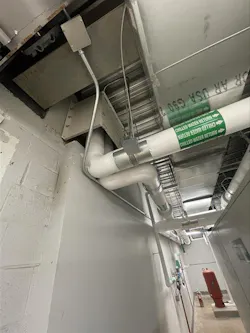
Piping penetrations exceeding 2.5 inches in diameter may be protected by incorporating an offset in the piping and enclosing it within a ¼‑inch‑thick carbon steel shroud located on the interior face of the shelter wall. The anchorage and structural detailing of this shroud must be reviewed and approved by a licensed structural engineer.
This method may also be applied to plumbing wall penetrations. When the design includes multiple roof penetrations for mechanical system piping, the use of a commercially available vault rated for the project’s wind and impact load requirements is recommended.
Ventilation Considerations (Tornado Season and Atmospheric Conditions)
Depending on the intended use of the tornado shelter, a fully operable HVAC system may not be required during a storm event. Standard 500 mandates only that ventilation be provided in accordance with Section 702.5, which may be achieved through natural or mechanical means.
Because most storm shelters serve as multi‑use spaces such as gymnasiums, restrooms, or breakrooms, the ventilation rates for normal occupancy must comply with local code requirements, which typically exceed those of Standard 500.
When evaluating natural ventilation, particularly in northern regions, it is important to consider both the typical tornado season and the atmospheric conditions that generate tornadoes. In the U.S., tornado season generally spans March through June, meaning the need for active heating or cooling during a storm event is limited, though local authorities may still require it.
Natural ventilation can be challenging due to the size, number, and placement of required openings. Each opening ideally should include an exterior‑rated louver, a control damper, and an interior grate or louver. A motorized interior louver may also be used if it aligns with architectural requirements.
In many cases, mechanical ventilation offers a more practical design solution, especially for facilities where HVAC systems must remain fully operational during a storm event. If the shelter’s HVAC equipment is required to operate during the event, mechanical ventilation needs are inherently addressed. If the HVAC system is not required to operate but is located within the shelter envelope, emergency power may be provided to the supply fan alone to meet minimum ventilation requirements.
When HVAC equipment is located outside the shelter and vulnerable to wind‑borne debris, designers may opt for a dedicated push‑pull mechanical ventilation system consisting of a supply fan and an exhaust fan operating simultaneously to deliver the required ventilation air. This approach can also leverage existing ductwork within the shelter to distribute ventilation air more evenly.
Emergency Cooling
Many tornado storm shelters, particularly those designed for K–12 educational facilities, do not require the HVAC system to operate during a storm event. However, mission‑critical spaces such as Emergency Operations Centers, 9-1-1 call stations, fire stations, and police stations may require portions or all of the HVAC system to remain operational throughout the event.
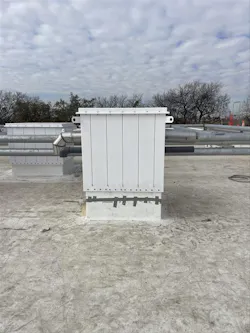
When continuous HVAC operation is required, all associated equipment should be located within the storm shelter envelope to the greatest extent possible. Particular attention must be given to protecting heat‑rejection components, which are especially vulnerable to wind‑borne debris and extreme wind loads. Protection strategies may include the use of geothermal heat exchangers or housing condensers within a hardened, ventilated structure designed to withstand the project’s wind and impact criteria.
Proper Sequencing of Equipment
It is important to keep in mind that just because the tornado shelter is occupied based on an issued tornado warning does not require the HVAC system to go on to emergency power. It is preferable to only transfer the shelter to emergency power on a loss of normal power. This is to extend the energy power source as long as possible in case the storm lasts longer than the typical two hours, or the shelter is unable to be evacuated after the storm for some reason. In this case, the occupants will still have ventilation air, lighting, and water.
Electrical
Emergency Power
In the event of a loss of normal power, tornado shelters must provide lighting, ventilation, and water for occupants for a minimum of two hours, as required by Section 702.9. The emergency electrical load can vary significantly depending on shelter size and the design approach used to meet these requirements.
Emergency power may be supplied by either a generator or battery system, depending on the required capacity and the anticipated duration of operation. Because tornado shelters typically require only a two‑hour backup period—and because exposed equipment must be protected from wind‑borne debris, uninterruptible power supply (UPS) systems are commonly used.
When a generator is required, such as for an Emergency Operations Center, it must be installed within a storm‑rated enclosure along with its associated fuel supply to ensure continued operation during a storm event.
Lighting Requirements
Section 702.7 requires community tornado shelters to provide exit signs and emergency egress lighting powered by the emergency electrical system. Section 702.8 further mandates a minimum of 1 ft‑candle of standby lighting at walking surfaces within occupied shelter areas and occupant support spaces. An exception allows shelters designed for fewer than 50 occupants to use personal lighting devices in lieu of standby lighting.
This exception, and others like it, should be evaluated carefully by the design team. Any personal lighting devices must be stored within the shelter, and because shelters may go years without actual activation, maintaining these supplies in a ready‑for‑use condition presents a significant operational challenge. Based on decades of experience designing and renovating facilities, it is unrealistic to rely on facility staff to consistently maintain such equipment.
Plumbing
Protection of Penetrations and Routing of Utility Services
Because protection of above‑grade pipe penetrations has been addressed previously, this section focuses on routing strategies that safeguard utility piping. Industry practice recognizes that below‑grade utilities are inherently protected from wind‑borne debris; therefore, whenever feasible, utilities serving the tornado shelter should be routed underground as they enter the structure.
This approach poses no difficulty for sanitary or roof drain outflows, but domestic water service can be more challenging. Based on experience, it is recommended that the storm shelter be provided with a dedicated domestic water line installed downstream of the meter, routed below grade, and brought up within a water room located inside the shelter.
While this strategy enhances reliability, it does not eliminate the potential need for on‑site water storage. Significant damage to the surrounding building could reduce municipal water pressure below acceptable levels for shelter operation. Emergency water storage considerations are addressed in the following section.
Domestic Water Requirements
Section 703.4 outlines the sanitary and domestic water requirements for storm shelters. While the standard does not mandate the provision of domestic hot water during a storm event, certain shelter functions may necessitate it. All community shelters must include at least one water closet, and shelters with an occupant load of 50 or more must provide additional water closets based on occupancy thresholds, along with a minimum of one lavatory.
When selecting plumbing fixtures, designers should consider fixture flow rates, particularly if the shelter will rely on emergency water or wastewater storage. The 2023 edition introduces a new requirement in Section 703.4.4.1, which addresses the need to store both domestic water and sanitary wastewater for use during a storm event.
Emergency Water System Design
Section 703.4.4.1 requires community storm shelters with an occupancy of 50 or more to provide a minimum of one gallon of domestic water storage per twelve occupants, as well as 1.5 gallons of wastewater or solid‑waste containment or disposal capacity per twelve occupants.
Several approaches can be used to meet the domestic water storage requirement:
• Bottled Water Storage:
If water is not required for sanitary fixtures, the storage requirement may be met by keeping bottled water inside the shelter. However, this option should be considered carefully. Bottled water must be stored within the shelter and monitored over long periods of inactivity. In practice, facility staff are typically focused on day‑to‑day operational needs, making it difficult for them to routinely check, rotate, and replace stored water supplies over time.
• Atmospherically Vented Gravity‑Fed Storage Tank:
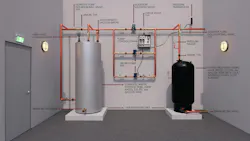
When water is required for sanitary fixtures, an atmospherically vented, gravity‑fed storage tank may be used. The tank must be elevated within the shelter to provide adequate pressure and allow full utilization of its volume. To prevent stagnation and associated health concerns, the tank must be installed in line with the domestic water service.
• Pumped Hydropneumatic Tank:
A pumped hydropneumatic tank is another option. Although more complex and maintenance‑intensive, it can be located anywhere within the shelter. As with gravity‑fed tanks, it must be installed in line with the domestic water service to avoid stagnation. The pump must be connected to the emergency power system.
Emergency Sanitary
Sanitary waste containment or disposal is typically addressed by installing a tank in line with the shelter’s sanitary outflow. Under normal conditions, waste flows through the system uninterrupted. In the event of a municipal sewer failure, the tank provides the required minimum storage capacity during the storm event.
Emergency Fuel Backup
Emergency fuel considerations typically arise when a generator is required to provide standby power for the shelter. If the standby power system is not classified as a life‑safety system, the generator may be fueled by either natural gas or diesel. In all cases, the fuel source must be housed within a rated enclosure to protect it from wind‑borne debris. Natural gas meters and piping may be routed into a ventilated, rated enclosure, provided coordination with the gas utility ensures access for meter reading and maintenance.
For facilities with extended operational requirements such as Emergency Operations Centers, the diesel fuel supply may range from 4,000 to 6,000 gallons. Given the size of these tanks, the designer must ensure that the fuel storage system complies with applicable industry standards, maintains required separation distances from occupied structures, and is located within a properly ventilated, rated enclosure.
Conclusion
This article is intended to provide engineers who are new to the MEP discipline with a foundational understanding of key design considerations for tornado storm shelter systems. The topics discussed highlight common challenges, typical design strategies, and practical lessons learned from real‑world projects. However, this document is not meant to serve as a comprehensive design manual. A fully detailed guide would require significantly more depth, and every storm shelter project presents its own unique conditions, constraints, and code interpretations.
Designers should view this information as a starting point, an introduction to the critical issues that must be evaluated early and coordinated thoroughly. Successful storm shelter design ultimately depends on close collaboration among mechanical, electrical, plumbing, structural, and architectural teams, as well as ongoing communication with local authorities having jurisdiction.
About the Authors
Richard Long, PE, is a mechanical engineering subject matter expert at KAI Engineering, and Aleksandar Milenkov, PE, LEED AP, is a principal at the firm, a division of St. Louis-based KAI Enterprises.