Are Your Load Calculations Code-Compliant?
Key Highlights
- ASHRAE Standard 183 requires detailed, three-dimensional modeling of building geometry and internal surface effects for load calculations;
- Traditional simplifications, such as using floor area alone, are insufficient to meet the new minimum requirements and ensure compliance;
- More rigorous methods like the Heat Balance Method provide better physical accuracy but require sophisticated software and workflows;
- Moving beyond peak-only calculations allows engineers to evaluate part-load performance and system behavior over an entire year;
- Adapting workflows to include comprehensive inputs and simulations enhances design reliability, energy efficiency, and compliance with current energy codes.
By NATHAN KEGEL, Senior Vice President, IES Ltd.
Heating and cooling load calculations are a foundational part of HVAC design – and probably carry the most risk for the engineering professional. For most engineers, the process is familiar: establish design conditions, apply accepted methodologies, and size equipment to meet peak demand.
What is less widely appreciated is that the expectations for how those loads are calculated have changed. With the adoption of ASHRAE Standard 183 into energy codes and standards, including the International Energy Conservation Code (IECC) and ASHRAE Standard 90.1, load calculation is evolving into a code-referenced process with clearly defined minimum requirements.
What Standard 183 Does (and Does Not) Require
ASHRAE 183 does not prescribe a single calculation method. However, in practice, meeting its requirements favors approaches that can efficiently represent three-dimensional building geometry. Those requirements include:
- Hourly solar radiation across all building room surfaces (not just exterior), including the effects of shading (Section 5.3);
- Representation of thermal mass on cooling load (Section 6.1);
- Hourly internal gains, including sensible, latent, radiative, and convective components;
- Occupancy diversity and activity levels that vary over time;
- System-level impacts, including duct losses, fan heat, and air-side processes such as mixing and reheat;
- Consideration of how loads behave beyond a single peak condition.
Where Practice and Requirements Diverge
In practice, load calculations have often relied on simplifications that were historically necessary, and widely accepted. But as technology has improved (from calculators and slide rules to personal computers) and research has advanced, the number and type of simplifications needed has changed and reduced.
For example, it has been common to define spaces based on floor area alone, rather than explicit geometry. A 100 ft² space might yield the same load result whether represented as 10 ft ×10 ft or 100 ft ×1 ft when using database-style input software. Similarly, solar gains may be approximated primarily at exterior surfaces, with simplifications of how solar radiation is distributed within the space. Interior surface effects and ground conditions are also often simplified or omitted.
These simplifications are insufficient to meet the requirements of Standard 183.
Accounting for solar radiation across all room surfaces, and capturing the interaction between those surfaces, requires explicit representation of room geometry and materials, beyond traditional spreadsheet or database-driven approaches.
The implication is that some commonly used workflows may not meet the minimum requirements of the standard, even if they have historically been considered acceptable practice.
Because Standard 183 is now referenced by both IECC and ASHRAE 90.1, this is no longer just a question of methodology, but a question of compliance. Simply put: omitting or merely estimating key elements such as internal surface effects can result in non-compliance.
Method Matters
ASHRAE leaves the choice of calculation method to the engineer, but the mathematical rigor and capabilities of those methods differ.
The Radiant Time Series (RTS) method is a simplified approach derived from the Heat Balance Method. It is relatively simple to apply and can be useful for determining peak design loads.
However, RTS has limitations. As noted in the ASHRAE Handbook of Fundamentals, it is not intended for full hourly simulation of load behavior. For systems where timing and interaction effects matter—such as heat pumps, heat recovery systems, or thermal storage—this limitation becomes significant.
The Heat Balance Method, by contrast, provides a more detailed and physically representative approach. As noted in the ASHRAE Handbook of Fundamentals, this method explicitly accounts for heat transfer between surfaces, air, and systems over time.
Tool and Workflow Constraints
The ASHRAE Handbook of Fundamentals, notes that both RTS and HBM require a “sophisticated computer program”. And while many software tools can meet the minimum requirements of Standard 183, the practicality of using them within the constraints of design schedules and budgets varies greatly. For example, manually determining how interior surfaces interact with one another without a three-dimensional model is both time-consuming and prone to error.
In practice, many teams are addressing this by adopting physics-based calculation and simulation environments with 3D geometry built in—such as the IES Virtual Environment (IESVE) — that can represent building geometry, system interactions, and apply the more accurate Heat Balance calculation methodology.
The key point is not that one tool is inherently correct and another is not, but that the ability to comply with Standard 183 depends on how well a given workflow can represent the underlying physics of the building without introducing excessive manual effort or risk of error.
Why This Matters Now
Historically, conservative assumptions and rules of thumb have been used to manage uncertainty in load calculations – especially given compact project schedules and tight design budgets. These practices helped reduce the risk of undersizing equipment, even if they resulted in oversized equipment. But energy code has recognized that accurate load calculations and equipment size are of critical importance.
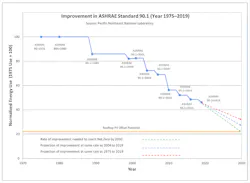
As shown in Figure 1, successive updates to ASHRAE Standard 90.1 (which IECC mirrors) have reduced allowable energy use significantly, particularly over the past two decades. Much of that improvement has come from reductions in internal gains and improvements to envelope performance.
The result is that modern buildings often have lower loads than the assumptions on which traditional rules of thumb were based. Reduction of load is a key driver in improving energy performance in buildings.
In this environment, reliance on outdated assumptions or simplified methods can lead to:
- Oversized equipment that may operate less efficiently at part load;
- Increased capital cost for equipment and related distribution systems;
- Control and thermal comfort challenges, including short cycling and humidity issues;
- Increased maintenance costs and shorter equipment life;
- Higher refrigerant charges;
- Discrepancies between expected and actual performance;
- Potential code compliance challenges;
- Impacts on both operational and embedded carbon.
The issue is not that traditional methods are incorrect per se, but that more current methods and updated inputs can lead to better results and performance, relative to design and project budgets, while also offering some reduced risk to the engineer of record.
Moving Beyond Peak-Only Thinking
Peak-load calculations remain essential; systems must still be capable of meeting design conditions. However, most buildings rarely operate at or near their peak load.
Heat pumps, thermal storage systems and heat recovery systems can benefit from understanding load ranges over the course of year. With current analysis tools, it is increasingly practical to evaluate performance across an entire year of operation—an 8,760-hour simulation—using the same underlying model, as shown in Figure 2.
This allows engineers to:
- Evaluate part-load performance, where systems spend most of their operating hours;
- Identify control and sequencing issues that are not visible at peak;
- Understand how different system configurations respond to varying conditions;
- Improve confidence in both sizing and expected performance;
- Test (virtually) how a given system capacity measures against the hourly calculated load.
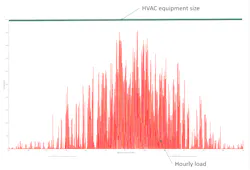
Importantly, this expanded analysis does not necessarily require a complete change in workflow; in many cases, it can be implemented as an extension of existing processes within the same software and from the same model used to calculate peak heating and cooling loads.
Aligning Practice with Evolving Standards
ASHRAE Standard 183 does not fundamentally change the role of load calculations in design, but it does set a new minimum for what is required to comply with energy code. And that may require more inputs than have traditionally been included in load calculation prior to Standard 183 being adopted into energy codes.
For engineering teams, this means taking a closer look at both methodologies and tools:
- Do current workflows capture the full set of required inputs?
- Are schedules and profiles varying in accordance with Standard 183 or does the “Design Day” schedule equal “Always On”?
- Are assumptions/inputs aligned with current code and standard requirements?
Understanding these questions is increasingly important as codes evolve and expectations for performance become more stringent.
Conclusion
Load calculation practices are evolving and the question engineers must ask themselves is whether their workflows, assumptions, and methods for QA/QC of results have kept pace.
ASHRAE Standard 183 formalizes a more comprehensive approach to load calculations. It incorporates factors not widely incorporated into “traditional” methods, and more accurately reflects the physics of buildings. It is also now required in many energy codes.
For engineers, the opportunity is not simply to comply with new requirements, it is to improve the reliability of design decisions, provide better value to their clients, and improve energy efficiency in buildings while reducing the first cost of HVAC systems.
About the Author
Nathan Kegel is Senior Vice President at Integrated Environmental Solutions (IES), where he works with engineering and construction teams to integrate building performance modeling into project delivery workflows. He advises contractors, developers and design firms on reducing compliance risk and improving energy performance outcomes across complex projects.
#####