Rethinking the Filtration-Energy Trade-Off in Large AHU Systems
Key Highlights
- The author found a 36.4% reduction in fan energy consumption using a hybrid filtration system with plasma ionization, compared to traditional MERV 16 filters;
- The hybrid setup achieved a 74% improvement in sub-micron particulate removal, addressing IAQ concerns more effectively than mechanical filtration alone;
- The findings challenge the notion that higher MERV ratings necessarily lead to increased energy use, showing that system resistance can be reduced with alternative technologies;
- Current filtration specifications often default to higher MERV ratings without considering energy impacts; hybrid systems offer a more balanced approach;
- The study supports expanding the use of validated air cleaning technologies within ASHRAE Standard 241 compliance frameworks, promoting energy-efficient IAQ solutions.

By TARANG PATEL, CPHC, TRV Mechanical Contractors LLC
In my experience, the mechanical engineering profession has largely treated the relationship between filtration efficiency and energy consumption as a settled trade-off.
Higher MERV ratings mean denser filter media, which mean higher static pressure across the air handling unit, which means the fan motor works harder to maintain design airflow. This logic is correct in isolation.
The problem is that it treats mechanical filtration as the only available air cleaning mechanism and in a post-pandemic environment where MERV 16 specification has become routine in high-occupancy facilities, this assumption is now generating significant and unnecessary energy penalties across the building stock.
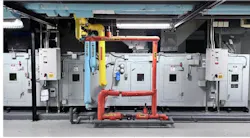
I want to challenge that assumption directly, because I have field data from a controlled study that I believe the profession should take seriously. The study was conducted on Air Handling Unit No. 7 at the Lincoln Center for the Performing Arts in New York City, under operational conditions, with rigorous instrumentation measuring both energy consumption and particulate removal performance before and after a configuration change.
The results were not marginal. They were large enough to prompt a reassessment of how we approach filtration specification in large AHU systems.
The ASHRAE 241 Context
ASHRAE Standard 241, Control of Infectious Aerosols has added regulatory urgency to the IAQ conversation without substantially changing the tools most engineers are reaching for. The standard establishes equivalent clean airflow requirements for occupied spaces and explicitly recognizes air cleaning technologies as valid mechanisms for meeting those requirements, provided their performance is empirically validated.
In principle, this should broaden the engineering conversation considerably.
However, in practice, most specifications I see still default to elevated MERV ratings as the primary compliance pathway, accepting the associated energy penalty as the cost of meeting the standard.
The reason for that default is understandable. High-efficiency mechanical filtration has a well-understood performance profile, a long track record, and straightforward commissioning verification. Air cleaning technologies that operate on non-mechanical inactivation principles -- plasma-field ionization being the most commercially mature -- have a less established field validation record, particularly at the scale of large commercial AHU systems. Filling that validation gap was one motivation for the Lincoln Center study.
Study Configuration and Methodology
The baseline configuration for the study was the unit's existing MERV 16 filter bank, installed under Lincoln Center's standard IAQ protocol. Baseline electromechanical load measuremender typical occupancy and air supply conditions.
Baseline particulate performance was characterized using Total Suspended Particle analysis, taken over a representative operating period in volumetric analysis per cubic foot of supply air, sampled at the unit's supply plenum.
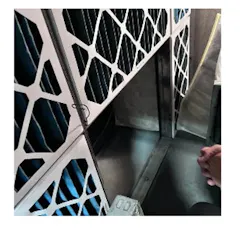
The intervention replaced the MERV 16 bank with a hybrid, two-stage configuration: a MERV 13, pre-filter stage providing primary mechanical interception of larger particles, paired with a 5,500-volt confined plasma-field ionization module enabling secondary inactivation of sub-micron biological particles downstream.
The plasma stage operates on the principle of non-thermal dielectric barrier discharge, generating reactive oxygen species and ions within a sealed chamber that inactivate airborne pathogens (bacteria, viruses, and mold spores) through chemical interaction rather than physical capture.
Critically, the MERV 13 pre-filter stage carries substantially lower flow resistance than the MERV 16 bank it replaced. The static pressure reduction across the filter section was the mechanism through which the energy effect was expected to manifest. Measurements were taken over matched operating periods at equivalent airflow settings under both configurations.
Results: The Numbers Are Not Incremental
Replacing the MERV 16 bank with the hybrid configuration produced a 36.4% reduction in total kilowatt-hour energy consumption at the fan motor, a 30.4% reduction in instantaneous wattage, and a 35.6% reduction in motor amperage. I want to emphasize the magnitude here: these are not marginal efficiency gains achievable through standard commissioning optimization.
A 36% reduction in AHU fan energy represents a fundamental shift in the unit's operating point, driven directly by the reduction in system resistance.
The trade-off between filtration efficiency and energy consumption is not a law of physics it is an engineering limitation.
The particulate removal results were equally significant. Total Suspended Particle analysis demonstrated a 74% superior particulate removal efficiency under the hybrid configuration, compared to the MERV 16 baseline, across the sub-micron particle size range most relevant to infectious aerosol transmission.
The mechanism is the plasma stage's ability to inactivate particles that pass through the MERV 13 mechanical layer, including the sub-0.3-micron biological particles for which mechanical filtration is least effective regardless of MERV rating. The combination of pre-filtration and plasma-stage inactivation addresses the full particle size spectrum more comprehensively than mechanical filtration alone.
Engineering Implications for ASHRAE 241 Compliance
The practical implication for mechanical engineers designing or retrofitting AHU systems under ASHRAE Standard 241 is significant. The standard's equivalent clean airflow framework explicitly permits air cleaning technologies to contribute to compliance.
The Lincoln Center data provides empirical field validation in a demanding, high-occupancy, real-world environment that a hybrid, plasma-enhanced configuration can exceed the particulate removal performance of MERV 16 filtration while simultaneously reducing operating energy by more than a third.
For buildings subject to New York City's Local Law 97 carbon emission limits, or operating under any performance-based energy code that penalizes excessive fan energy consumption, this outcome resolves what has appeared to be a fundamental conflict: the obligation to improve IAQ under Standard 241, and the obligation to reduce carbon emissions under LL97.
On the evidence from this study, that conflict is not inherent. It is a product of limiting the design toolkit to mechanical filtration alone.
Granted, I recognize that a single controlled study on one air handling unit at one facility does not constitute universal proof.
Other building types, other unit configurations, and other occupancy patterns may produce different relative results. But what the Lincoln Center study does establish is that the assumption of an inevitable trade-off deserves to be challenged with field data rather than accepted as given.
So I contend that our profession should be generating more of that data.
A Note on Specification Practice
Of note, I also want to offer a direct observation about how filtration is currently specified in high-occupancy buildings. The default trajectory since 2020 has been upward MERV escalation from MERV 13 to MERV 14 to MERV 16 as a response to infectious disease transmission concerns. That trajectory has been driven by legitimate public health objectives, but it has been implemented with insufficient attention to the energy consequences.
In a large AHU system operating 24 hours a day, the cumulative annual energy cost of the additional static pressure from a MERV 16 bank is substantial. In a portfolio of buildings, it is very substantial.
The alternative I am proposing is not reduced filtration performance. It is a more sophisticated approach to achieving the same or better performance through a hybrid architecture that decouples inactivation efficiency from mechanical resistance.
Engineers who specify filtration systems in high-occupancy facilities should, in my view, be evaluating plasma-enhanced hybrid configurations as a matter of course, not as an exotic alternative. The field data now supports that evaluation.
Conclusion
The engineer closest to the installation details often sees what the design document misses. In this case, what I saw was a filtration specification that was meeting its IAQ objective while imposing an unnecessary energy penalty. But that penalty could be eliminated, not just reduced, through a different system architecture.
A 36.4% reduction in energy consumption and a 74% improvement in sub-micron particulate removal, achieved simultaneously under operational conditions, is evidence that this profession should take seriously. Indeed, the filtration-energy trade-off is not inevitable. It is a design choice.
####
The author is an HVAC mechanical engineer with TRV Mechanical Contractors LLC in Kenilworth, NJ. Contact him at [email protected].