S&P Economic Outlook: Curb Your Enthusiasm
Key Highlights
- U.S. GDP growth is forecast at 2.2% for 2026, with a slowdown expected in subsequent years due to geopolitical tensions;
- Inflation may reach 4% temporarily, driven by a supply-driven oil shock, but core inflation is expected to stay around 3%;
- Construction costs are rising across all components, with significant increases in turbines, copper wire, and ocean freight rates;
- Logistics disruptions from the Middle East conflict are causing higher shipping costs and delays, impacting supply chains for construction materials;
- Labor shortages and rising metal prices are contributing to increased costs and project delays in the engineering and construction sectors.

SAN FRANCISCO & NEW YORK CITY, March 25, 2026 -- The enthusiasm around U.S. growth momentum that prevailed as recently as February has been tempered by the escalation of the Middle East conflict, S&P Global Ratings said today in "Economic Outlook U.S. Q2 2026: Curb Your Enthusiasm."
As a result, S&P now forecasts 2.2% GDP growth for the U.S. in 2026, followed by an average of 1.9% in 2027-2029. This assumes a temporary, supply-driven oil shock that recovers inside the year.
"The recent oil shock could push headline inflation toward 4% in the near term, but we expect core inflation to move only moderately higher (3%) since our base case assumes the supply disruption will be temporary," said Satyam Panday, S&P Global Ratings Chief Economist, U.S. and Canada.
Labor market conditions have softened but remain broadly consistent with trend growth. S&P anticipates the U.S. unemployment rate to drift higher in the later part of 2026 and 2027, as output growth slows below potential.
S&P also pencils in one rate cut of 25 basis points (bps) late this year, followed by an additional 75 bps in 2027, as the Federal Reserve pushes the policy rate toward the lower bound of neutral.
Risks to the growth outlook are squarely to the downside, primarily linked to the duration and severity of the ongoing conflict in the Middle East.
Reports and Ratings information can be found on S&P Global Ratings' public website by using the Ratings search box at www.spglobal.com/ratings.
Construction Costs Up as Materials, Equipment Prices Rise
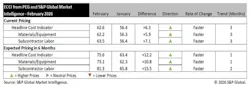
A monthly measure of PEG and S&P Global Market Intelligence, the Engineering and Construction Cost Indicator (ECCI) is a leading indicator measuring wage and material inflation for the engineering, procurement and construction sector. This measure increased to 69.2 in March, from 62.6 in February. That means prices are increasing for this sector in March and specifically, the sub-indicator for materials and equipment costs increased by 11.7 points to 73.9, while the sub-indicator for subcontractor labor costs decreased by 5.2 points to 63.5.
The materials and equipment indicator continued to grow in March, with increases reported in all the twelve tracked components compared to February. The most significant gains were observed in turbines, as well as in ANSI Pumps and Compressors. These components scored above 70.0, with copper-based wire achieving the highest score. Alloy steel pipe and copper—based wire experienced smaller increases, but as mentioned copper saw the highest reading of all categories. Ocean freight had a notable increase of above 10.0 points signaling the complications related to logistics in the current climate.
“Containerized freight rates are set to rise sharply, even in a softer pricing environment, due to higher shipping costs from the Middle East (MENA) conflict,” said Keyla Goodno, Senior Economist. “War-risk premiums, increased insurance, fuel surcharges, and congestion fees are pushing delivered costs up—often faster than commodity prices. Shippers should expect stricter carrier allocations and more schedule changes as networks adjust when importing equipment. Alternate routes are emerging, with some carriers using inland networks in Saudi Arabia to bypass sea disruptions.”
The sub-indicator for current subcontractor pricing decreased to 58.3 in March, indicating a deceleration from the recent trend. The indicator remains above 50.0, signaling rising prices. Most categories remained stable with 12 categories scoring a neutral 50.0. The Midwest showed moderate gains, particularly in mechanical and I&E, which reached 75.0. The South exhibited similar behavior in I&E scoring 83.3. Overall, subcontractor pricing shows similar results as last time with prices still maintaining a rising behavior.
The six-month headline expectations for future construction costs indicators bounced higher to 87 in March. The expectations indicator for materials and equipment reached 85.0, which is 11.7 points higher than last month’s figure. In March, all categories scored above the 50-mark, with notable increases of 25.0 points in Shell and Tube Heat Exchangers, and 33.3 points in Redi-Mix Concrete. Additionally, turbines saw an increase of 25.7 points and Ocean Freight from Asia to the US 14.6 points. Turbines had dropped during February but have now bounced back to a fast growth in prices during March.
The six-month expectations indicator for subcontractor labor costs rose to 91.7 making it the highest scoring category. This indicator grew from 81.3 in February, reflecting a 10.4-point increase. Notable increases were observed in the US Midwest and West for both I&E and Mechanical categories jumping 16.0 points. Additionally, the Western and Eastern Canada categories also demonstrated strength, with the Eastern growing 25.0 points. Overall, the outlook for subcontractor labor costs continues to trend upward.
Respondents indicate that the market is experiencing significant shortages in general laborers, pre-cast piles, and medium voltage cable, while transmission and substation steel manufacturers are oversold, raising quality and schedule concerns. Many suppliers across various material and equipment types are struggling to meet contract delivery dates due to sub-supplier issues, workforce shortages, and overcapacity. Additionally, rising metal prices, particularly for copper and zinc, are complicating the supply of electrical equipment, including transformers and switchgears.
Respondents and professionals report that the U.S. market is becoming highly active, with new power projects and data centers emerging. They highlight tightening supplies for transformers, electrical bulk materials, and large turbines. Rising freight costs and insurance premiums, driven by geopolitical tensions, are causing uncertainty in finished product pricing.
#####
For more, go to: PEG Engineering and Construction Cost Index (ECCI) | S&P Global
About S&P Global Market Intelligence
S&P Global Market Intelligence is a division of S&P Global (NYSE: SPGI). S&P Global is the world’s foremost provider of credit ratings, benchmarks, analytics and workflow solutions in the global capital, commodity, and automotive markets. With every one of our offerings, we help many of the world’s leading organizations navigate the economic landscape so they can plan for tomorrow, today. For more, visit www.spglobal.com/marketintelligence.