BAC Releases New Evaporative Condenser Piping Manual
Key Highlights
- Baltimore Aircoil Company has created a detailed Evaporative Condenser Piping Manual to improve design, safety, and efficiency in ammonia refrigeration systems;
- It provides comprehensive guidelines on piping design, including discharge piping, drain lines, and thermosiphon sizing to ensure system stability;
- The manual emphasizes the importance of proper pipe sizing, layout, and support to prevent issues like liquid backup and unstable operation;
- Includes safety considerations aligned with industry standards for ammonia refrigeration, focusing on maintenance, venting, and hydrostatic protection.
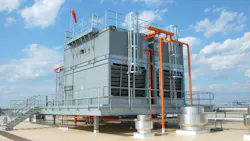
Jessup, MD, October 5, 2026 — Baltimore Aircoil Company, Inc. (BAC) announced the release of its new Evaporative Condenser Piping Manual, a technical resource developed to help engineers, contractors, system designers, and facility professionals properly design evaporative condenser piping for industrial refrigeration systems.
The manual provides piping guidelines and methodologies intended to support stable system operation, maintain optimal system efficiency, and lower the system charge. It focuses primarily on evaporative condensers using ammonia as the system refrigerant, while noting that the principles of thermodynamics, heat transfer, and fluid dynamics apply to the other similar refrigerants as well.
“This manual brings together engineering guidance, field experience, and R&D lab test data-based recommendations to help designers avoid common issues with the condenser installations, such as liquid backup into the condenser(s), improper refrigerant flow from condenser outlet to the high pressure receiver, and unstable system operation. Our goal is to give the industry a comprehensive and practical technical resource that supports safer, more reliable, and efficient ammonia refrigeration systems,” said Hussnain Yaser, P.E., Senior Principal Engineer at BAC.
This manual addresses several critical piping considerations, including high-stage discharge piping, condenser drain line piping, liquid drop leg height sizing with and without thermosiphon cooling, P traps with open-channel flow in condenser drain headers, equalizer and thermosiphon vent sizing, hydrostatic overpressure protection, and purge piping.
A key focus is the importance of proper pipe sizing and balanced layout for stable system operation at all conditions. The document also explains that improper evaporative condenser piping can contribute to increased energy usage, increased refrigerant charge, liquid backup into condensers, unstable system operation, and other issues. It also emphasizes that piping arrangements should account for local code requirements, IIAR piping recommendations, site-specific conditions such as wind and seismic loads, and proper support of all piping and equipment.
The manual includes BAC’s recommended piping configurations for both multiple condenser and single condenser installations. These guidelines are intended to help users evaluate their piping layouts more carefully and apply the BAC recommendations to real-world industrial refrigeration applications.
In addition to design guidance, the manual highlights important safety considerations related to ammonia refrigeration systems. It notes that ammonia system maintenance, piping work, and refrigerant venting must be performed in accordance with applicable local, state, and federal laws using accepted industry safety practices, and it includes guidance related to condenser hydrostatic overpressure protection.
For more information, visit the BAC resources page.
About BAC
BAC is proud to be the world’s cooling partner. Since 1938, BAC has created sustainable comfort cooling, process cooling and refrigeration solutions for essential and demanding environments around the world. The company serves customers across industrial processes, HVAC, industrial and commercial refrigeration, data centers and other infrastructure markets. BAC designs and manufactures heat transfer and thermal management equipment, including cooling towers, condensers, hybrid, adiabatic and dry products and related technologies, helping customers achieve long-term performance, reliability and environmentally responsible outcomes.