Colossal Cave Network Needed Evaporative Cooling
Key Highlights
- Vast underground caves in Missouri are being repurposed for commercial storage, data centers, and government facilities;
- Specialized cooling systems, including EVAPCO's evaporative fluid coolers, are used to regulate temperature and eliminate heat buildup in subterranean environments;
- This project involved retrofitting existing underground spaces with above-ground cooling units to maintain stable temperatures and prevent heat-related disruptions;
- The underground complex features extensive tunnels, roads, and railways, with natural limestone formations;
- Implementation of these cooling systems has successfully reduced underground temperatures by up to 30°F, ensuring operational stability and energy efficiency.
By JOHN VASTYAN, Common Ground
A subterranean wonder thrives deep beneath rural farmland where dairy cattle graze peacefully and tractors harvest soybeans and corn. Unseen from above is a startling treasure trove below: vast caves repurposed for commercial enterprise and storage.
Spelunking is typically referred to as a sport for adventurers. Though, deep within the confines of this facility, activity is more about maneuvering full size tractor-trailers as they disgorge their valuable cargo to be stored in warehouse spaces built within cavernous limestone rooms – turning modern logistics into a real-life game of “Where's Waldo?”
In a world where commercial storage units boast climate control and 24-hour access, these caves are a sassy nod to the past, proving that sometimes the best place to store treasure is, literally, underground.
For many first-time visitors to the vast cave system, it’s stranger than fiction.
“It’s a very unique project, and although we’ve provided equipment for caves before, this one was definitely different,” said Cody Bemis, sales engineer with manufacturer’s rep firm, Sys-Kool, based in Omaha NE, with branches in Missouri, Colorado, Arkansas, and Tennessee.
Bemis, based in Belton MO, reflected back on a call he received from a pre-construction manager for Design Mechanical, Inc. (DMI), a firm specializing in commercial work, based in Kansas City, MO, with offices in Denver and Quincy IL.
In his no-flair, pragmatic way of explaining things, Bemis’ caller from DMI informed him that they were bidding on a mechanical system to include two large fluid coolers, with a total capacity of 330 tons.
Anticipating a drive to the site and to meet with the project team, Bemis asked, “OK, where’s the job?” He expected to receive an address near Columbia or Springfield. Instead, Bemis was given an address well beyond the Kansas City KS metro area. The caller added that the rural location was remote, and not the easiest to get to.
Puzzled, Bemis fed the address into his computer to find nothing but cultivated fields and pastureland. He switched to Google Earth and magnified the image. While still on the phone, he said, “I’m looking at a satellite image of the address. There’s nothing but cultivated fields and pasture out there.”
“Yup, that’s the place,” the caller replied.
“Go again?” asked Bemis.
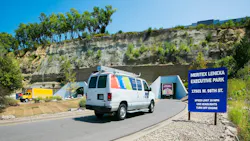
“If you look a few hundred yards to the West of the GPS location I provided,” added the caller, “you’ll see some signage and a driveway that leads to a tunnel opening.”
“A tunnel,” replied Bemis. “You mean, like a driveway to something... going underground?”
“Yup," came the answer. "The job’s below ground. In a cave – a really big one.”
Later that day, Bemis met with Ryan Smith, who was then the sales engineer at Sys-Kool chosen to visit the jobsite. (Smith is now a service manager at Trane, in Kansas). They went over some of the specifics: the need expressed by DMI called for two 9-ft-x-12-ft EVAPCO ESW4 evaporative fluid coolers, each with a cooling capacity of 165 tons.
Smith learned that the location was owned by firm that specializes in the ownership and management of underground storage facilities, and was in fact – at 55,000,000 sq ft – the world’s largest underground storage and commercial facility!
“That’s what we anticipated, based on the description given to us,” explained Smith. "But, my trip there the next day to visit with the project team would iron out any questions. We’d then be able to make exact equipment specifications.”
Sure enough, Smith’s GPS misdirected him a few times as he drove along an odd mix of “paved cow paths” in a landscape with few features. But he eventually found the tunnel. Below ground, the labyrinth he entered was strangely foreign.
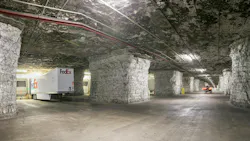
After passing through several stages of security, Smith found himself in a remarkably clean, spacious subterranean commercial area with plenty of parking spaces. “There were big semis down there, with plenty of room to turn around,” he noted. Giant hallways with 20-ft ceilings led in many directions.
Sorry, that’s classified
Smith learned that the underground development, and the real estate above it, is owned by one of the leading U.S. firms specializing in commercial development and management of cave systems. One of the tenants of the underground park was a government entity urgently in need of highly specialized, environmentally-controlled space, about 500,000 sq ft in size.
“Who is it? he asked.
“Sorry, that’s classified,” was the quick reply.
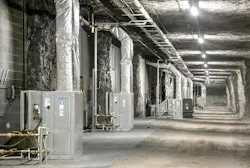
The concealed facility has an extensive grid of 16-ft-x-40-ft wide tunnels separated by 25 ft square limestone pillars created by the “room and pillar” method of hard rock mining, with portions of the layout at least initially determined by the movement of water millions of year ago. All told, the sprawling underground complex contains about 11 miles of illuminated, paved roads and several miles of railroad track. There’s also plenty of room for future expansion down there.
The underground space naturally maintains temperatures between 65 and 70 °F year-round – unless there’s an artificial heat source. And that’s why Smith was there. “I really had to wonder why I was so warm down there,” he said.
The answer was that the government’s operations below ground – likely, large computers and data storage – were creating heat. So much of it that it was disrupting the stable, below-ground temperatures. In fact, neighboring lease-holders were complaining. So, Bemis learned, this was the situation that shaped the need for cooling towers.
Sys-Kool represents EVAPCO, a leading manufacturer of cooling towers and heat transfer technologies. Smith learned that a delivery of a competitor's coolers had been promised for climate control, but defaulted technologies. Deadlines were missed because of lead-time issues; this led to the opportunity Smith now had to specify and make arrangements for the successful delivery of a cooling solution – even though it meant he would have to have the equipment ready for rigging in half the usual time.
Underground discomfort
Design Mechanical’s senior project manager Fred Gicinto explained that the new cooling solution was needed as a retrofit. Originally, about a decade earlier, air-cooled packaged systems were chosen to condition the leased space underground – with ductwork arranged along walls in the cave. There were 23 condenser air systems, each essentially blowing heat into the cave and, over time, the accumulation of BTUs was untenable.
“The packaged units created a situation where some of the underground spaces were heated up to 90 to 100°F," Gicinto noted. "There was too much condenser heat, and humidity. Heat was migrated out through the walls to other areas of the cave. It was trapped, with nowhere to go – a challenge that needed a solution,” he explained.
There were other data centers down there, too, as well as beer and liquor distributor storage facilities, offices, and varied warehouse space. The accumulation of heat would threaten the stability of business for the facility’s owners.
Apparently, there was also the issue of a service road blowing heat into the space. Not much, but some, all of which was – like heat captured by condensers – absorbed into the stone mass of the cave.
Bemis returned to Sys-Kool with a better idea of how to specify the right above-ground coolers. The new solution, said Bemis, was designed to remove heat, and wouldn’t add any in the process. Facility managers stated the need for a zero-BTUs (heat) tolerance.
Specifying for performance
In addition, the design team settled on a plan for 330 tons of evaporative cooling, needed to shed heat from a just-installed water-sourced heat pump system. To transport thermal energy out of the cave, several 6-ft circular, 100-ft-long chases were drilled near a few of the cave’s main entrances. These were used as conduits for electrical and piping – moving supply and return fluids between the heat pumps and evaporative coolers.
EVAPCO’s largest and most energy efficient single-cell evaporative cooler was chosen for the job. The new 14-ft-x-22-ft ESW4 is designed to maximize capacity and to optimize energy efficiency, developed specifically for high-capacity uses such as for data centers, industrial plants and large HVAC applications where end users require the lowest energy consumption with fewest units, connections and fans.
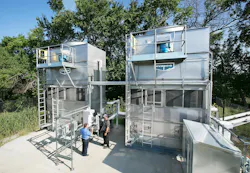
According to Bemis, the ESW4 is designed with IBC compliant construction, FM-approved construction and also with independently CTI-certified performance. The cooler lines offers more than 230 models with a broad range of tonnages, providing between 270 and 670 nominal tons in a single cell. The design eliminates the need for a discharge hood with dampers, and reduces freezing risks. The ESW4 uses only sensible cooling to eliminate water evaporation from the coil, which reduces scale build-up.
“It is our most efficient fluid cooler," explained Bemis. "The coil sits above the cold water basin, not exposed to direct air flow. That arrangement is chiefly the reason for system efficiency and long life. As water falls from the film media, pre-cooled water is captured.”
Two coolers were specified, each providing 165 tons of capacity.
Cooler cave temps return
Beginning in July of 2022, the new coolers were delivered and installed. Soon, rigging and piping were complete. Bemis and Smith were on hand for Sys-Kool during system commissioning and training of DMI technicians who now service the equipment.
By eliminating the heat source in the underground space through the use of above-ground fluid coolers, the core temperature of the cave dropped quickly.
“By November of that year, the temperature had dropped by 22°F underground, a huge relief for the tenant and facility managers,” recalled Smith. By mid-August of the following year, subterranean temps had dropped 30°F.
“The goal, achieved and then exceeded, was to return the entire facility to natural cave temperatures of about 65°F," he added. "Managers of the storage facility have since purchased and installed another fluid cooler for use elsewhere, another indication of their satisfaction with the technology.”
####
About the Author
JOHN VASTYAN
Based in Manheim PA, Vastyan entered the HVAC, hydronics, plumbing & mechanical trade communications business in 1987 at Godfrey Advertising, where he served as PR director. He has remained active in those industries ever since, adding radiant heat/cooling, geothermal and solar. Since 9-11-01, he has owned Common Ground, a trade PR firm, now representing Fujitsu, Watts, Watts Radiant, EVAPCO and Taco Comfort Solutions, among other clients. The firm seeks only non-competitive relationships with firms in the broad construction industry, favoring PR and editorial work with manufacturers of mechanical systems. Email: [email protected].