Wildfires, Data Centers, and Engineers
When I was 13, I recall waking up wheezing in the middle of the night at my family's summer cottage in New Jersey, 50 miles west of our year-round apartment in The Bronx, NY. I had not yet been diagnosed with asthma, so I was without the rescue inhaler that would become my constant companion for the rest of my life.
Having had a similar experience years earlier with one of my older brothers, my Dad tossed me into the car and started driving into the city. By the time we were crossing the George Washington Bridge, I was breathing fine. But my life had been changed forever.
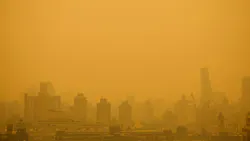
I was reflecting on that personal turning point this July when thick smoke from massive Canadian wildfires sent so many of us indoors. Minneapolis, Detroit, Toronto, Chicago, Cleveland, New York City, Boston, and more, all were blanketed with a hazardous haze that had residents constantly checking the newly installed air quality apps on their phones.
Conditions were so bad that ASHRAE reissued the guidance it had updated for building owners and engineers in late 2024 and early 2025 in response to the record California wildfires at that time. Such resources include ASHRAE Guideline 44-2024, Protecting Building Occupants from Smoke During Wildfire and Prescribed Burn Events. The aim of the guideline is "to provide a series of actions to be taken to reduce the risk of smoke infiltration into a building, protect its occupants from smoke, and reduce the need for evacuation. It addresses risk reduction, guidance on selecting appropriate smoke management strategies, and information on air filtration and air-conditioning systems for smoke control."
In June 2025, the Society also published this statement:
ASHRAE’s view is that building owners/operators should take proactive measures to reduce exposure to wildfire smoke to manage negative IAQ impacts. These include reducing outdoor air intake during high levels of wildfire smoke; installing effective filtration and cleaning systems; sealing cracks or gaps where outdoor air smoke can enter the building; monitoring IAQ conditions with reliable instruments; raising awareness among occupants about potential health effects of wildfire smoke exposure; using portable air filtration devices (HEPA or high MERV) when necessary; ensuring proper maintenance of HVAC systems; providing greater access to equipment such as respirators or masks when needed; consulting with local public health officials when necessary; and offering support services for those affected by poor IAQ conditions caused by wildfire smoke.
One thing that occurs to me here is that, unlike the vast majority of sentient beings on this planet, readers of this magazine and other engineers devoted to this industry actually have the opportunity to help fix these public health challenges. You don't have to sit back and wonder what the experts are recommending to ensure better breathing. Many of you are the experts. And all of you are problem-solvers.
Which means that you also have the chance, and arguably the duty, to weigh in and advise on some of the most compelling issues of our time. Data centers, for instance, are growing at an astounding rate, as detailed in this article by ACEC's Diana O'Lare, CPSM. And already, there are 10 times as many data centers being built in the U.S. as there are in the next most active country.
The most alarming issue, of course, is energy usage, which is jaw-dropping by any measure. One incredible example is the fact that data centers in Utah reportedly already use more energy than the rest of the state combined. Think about that.
Think also about the hope offered once again by Dr. Stephanie Taylor, M.Arch, in this issue's cover story. She notes how new research into the human microbiome has revealed an important new ally that, if deftly managed, can be used to improve indoor environmental quality for all of us.
It is significant news that once again highlights how unusually consequential the contributions are that this industry can make to help us all breathe easier. My own lungs are very appreciative.
####
About the Author
Rob McManamy
Editor in Chief
An industry reporter and editor since 1987, McManamy joined HPAC Engineering in September 2017, after three years with BuiltWorlds.com, a Chicago-based media startup focused on tech innovation in the built environment. He has been covering design and construction issues for more than 30 years, having started at Engineering News-Record (ENR) in New York, before becoming its Midwest Bureau Chief in 1990. In 1998, McManamy was named Editor-in-Chief of Design-Build magazine, where he served for four years. He subsequently worked as an editor and freelance writer for Building Design + Construction and Public Works magazines.
A native of Bronx, NY, he is a graduate of both the University of Virginia, and The John Marshall Law School in Chicago.
Contact him at [email protected].