Constant Operation, Still Net Zero Ready
By MARK BRADBY, PE, and JOHN MAUST, Technical Designer, LEO A DALY
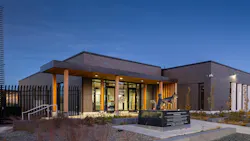
The new Hennepin County Sheriff's Office Public Safety Services Headquarters in Plymouth, MN, was designed with a clear ambition: create a facility that operates around the clock, serves the community reliably, and is positioned to achieve net zero energy.
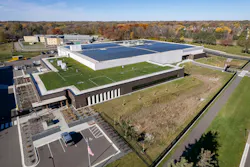
The 100,044-sq-ft building pairs groundwater geothermal wells with six-pipe heat recovery chillers with chilled beams, energy recovery ventilation, rainwater reuse, a green roof, and an approximately 860 kW bi-facial solar array. Together, these strategies are projected to produce more energy than required for the building’s annual use.
Throughout design, the project reinforced several practical lessons. In a heating-dominant climate, geothermal systems must be sized to meet extreme winter peaks. Rainwater reclamation tanks to harvest water for re-use need generous overflow capacity in areas with abundant rainfall. And when a roof carries multiple systems — in this case, green roof assemblies, major mechanical equipment, and a large photovoltaic array — coordination must begin early and remain constant.
In the end, the facility opened in April 2025 and later earned a Minnesota ASHRAE Technology Award, demonstrating that even complex, 24/7 public safety buildings can be truly ready for net zero.
Designed to be Net Zero Ready
Energy considerations included:
-
The project was required to meet Minnesota’s B3 (Buildings, Benchmarks & Beyond) energy standard, targeting performance at least 80% better than a code baseline building — this directly shaped the envelope design, electrified heating strategy, and on-site renewable generation.
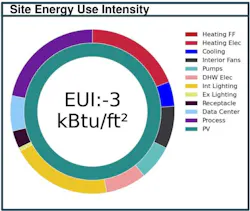
- Minnesota is a heating-dominant climate, so any building aspiring to net zero must solve for winter first. With a projected energy use intensity (EUI) of –3 kBtu/sf/yr, the facility performs dramatically better than the median EUI for comparable law enforcement public buildings in this climate region (approximately 63 kBtu/sf/yr), underscoring the impact of its electrified and heat recovery–driven design strategy.
Groundwater-Based Geothermal and Heat Recovery Chillers
At the heart of the system are two deep closed-loop groundwater-based geothermal wells. Rather than installing dozens of closed-loop wells and boreholes, the design uses significantly fewer groundwater heat exchangers as a heat sink and source, providing substantial heating and cooling capacity from just two wells. The wells feed modular heat recovery chillers in a six-pipe configuration that simultaneously produces both chilled water and heated water.
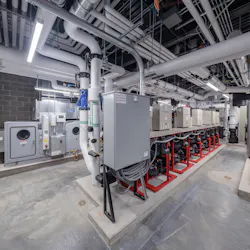
This arrangement allows heat to be moved around the building before engaging the groundwater well. In winter, interior spaces with cooling loads transfer excess heat directly onto the heating water loop. During simultaneous heating and cooling, the chillers operate at a coefficient of performance (COP) approaching 6.8. The system is projected to reduce overall energy consumption by 40% compared to a typical HVAC system.
A condensing boiler plant provides redundancy and winter peaking capacity, particularly when snowmelt systems and garage vehicle exhaust systems are active. Under normal operations, however, the building is heated electrically through geothermal energy.
Dedicated Outdoor Air + Chilled Beams
Office areas in the building are served by a dedicated outdoor air system (DOAS), paired with a four-pipe chilled beam system.
The DOAS delivers 100% outside air to all occupied spaces. A low cross-leakage energy recovery wheel reclaims exhaust energy while maintaining air classification compliance. The unit is sized to handle the full latent load of the office areas and to meet ASHRAE 62.1 ventilation requirements.
Chilled beams address sensible loads. Because chilled beams require approximately 1/3 the airflow of a traditional VAV system, fan energy is reduced and mechanical distribution is simplified. With no terminal fans, filters, or motors in occupied zones, long-term maintenance demands are also minimized.
High-Efficiency Garage Ventilation
The 72,000-sq-ft indoor garage houses squad vehicles, K-9 kennels, boats, occupiable spaces and various technical equipment. Ventilation requirements are substantial and variable.
Four energy recovery ventilators, controlled by air quality sensors, ramp the airflow up to code-required levels when needed while recovering up to 86% of exhaust energy during winter. Without heat recovery, exhausting that volume of heated air in January would significantly undermine net zero goals.
Rainwater Reclamation
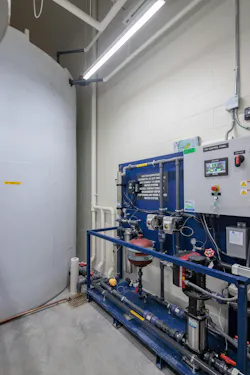
All toilet flushing water is supplied from a rainwater reclamation system. Roof drainage is filtered and stored in a 4,300-gallon tank, then distributed through a dedicated non-potable system.
The system reduces potable water demand and stormwater discharge. In practice, it also highlighted how quickly rainfall can accumulate in Minnesota - and the importance of overflow design.
Green Roof
Nearly 20,000 square feet of green roof covers the office portion of the building. The vegetated roof:
-
Reduces stormwater runoff;
-
Slows peak discharge rates;
-
Lowers summer heat gain;
-
Protects roofing membranes.
In high-performance buildings, energy load reduction is as critical as renewable energy generation. The green roof contributes to both energy goal achievement and is a source to slow down and capture stormwater compounding strategies for maximum impact.
Bifacial Solar Array
An approximately 860-kW rooftop solar array, installed primarily over the garage roof, completes the energy strategy. Bifacial panels capture reflected light from below, which reflects off the white roofing material to the underside of the panel, increasing production.
Energy modeling analysis predicts that the solar array will more than offset the building’s annual site energy use, resulting in a negative EUI. As the electric grid continues to decarbonize, operational carbon emissions will decline further.
Lessons Learned
1. Size Renewable Heating for Winter Peaks
In many commercial projects, cooling drives equipment sizing. Here, heating dominated. Detailed winter load modeling was essential to ensure the geothermal wells could meet peak demands. Snowmelt loads and simultaneous heating conditions required careful analysis. The backup boiler system provides confidence if the six-pipe chiller needs urgent maintenance during heating season and also during extreme conditions, but the primary geothermal capacity had to be robust.
The lesson is simple: in a heating climate, renewable heating systems must be sized with margin.
2. Plan for Abundant Rain
The 4,300-gallon rainwater tank filled quickly during commissioning and overflowed more frequently than expected. The system performed as designed; the rainfall simply exceeded conservative modeling assumptions.
Adequate overflow routing and site drainage coordination are critical. In Minnesota, rainwater reclamation design should assume plenty of rain — not scarcity.
3. Treat the Roof as Shared Infrastructure
Between green roof assemblies, mechanical equipment, service clearances, and a large photovoltaic array, the roof became one of the most coordinated areas of the project.
Panel orientation, maintenance pathways, structural loading, vegetative depth, and equipment access must all be reconciled early. When a building is targeting net zero, the roof is strategic infrastructure, rather than leftover space.
Beyond the Metrics
The performance numbers are compelling: high performance heat recovery chillers, aggressive energy recovery, electrified heating, and a solar array projected to exceed annual consumption. These elements contributed to the project’s Minnesota ASHRAE Technology Award recognition in 2025.
But the broader achievement is integration. A 24/7 public safety facility now operates with:
-
100% outside air in office areas
-
Reduced fan energy through chilled beams
-
High-efficiency garage ventilation with heat recovery
-
On-site water reuse
-
Renewable thermal and electrical energy
-
A projected energy use intensity (EUI) of -3 kBtu/sf/yr.
Net zero readiness was not achieved by a single technology. It was a combination of load reduction, energy recovery, electrification, and on-site generation.
The Hennepin County Sheriff’s Office Public Safety Services Headquarters stands as proof that with integrated design, innovative engineering, and a commitment to sustainability, even the most demanding 24/7 public safety facilities can achieve net zero energy performance.
About the Authors
Mark Bradby, PE, is a seasoned mechanical engineer with 25 years of experience in the construction industry, specializing in high-performance systems and project management. As mechanical engineering practice lead at LEO A DALY, Mark is dedicated to advancing environmental sustainability and optimizing building performance.
John Maust is a senior technical designer at LEO A DALY with more than a decade of experience focused on mechanical engineering projects and assessments. He has contributed to a range of facility types, including public safety, innovation centers, and higher education, bringing technical expertise and a collaborative approach to every project.