Digital Twins and the Future of High-Performance HVAC Systems
Key Highlights
- Digital twins create 'live' digital representations of HVAC assets, enabling real-time performance monitoring and optimization;
- They also facilitate a shift from reactive to predictive maintenance, reducing downtime and costly repairs;
- By modeling interactions across systems and sites, digital twins support energy efficiency and coordinated control at multiple scales;
- Integration of AI enhances prediction accuracy and control responsiveness, especially in complex or mission-critical facilities.
By KEVIN LAIDLER, Global Director, Consultant and Specifications, Armstrong Fluid Technology
Engineers, building owners, and facility operators are under growing pressure to cut energy use, lower carbon emissions, improve reliability, and extend equipment life while managing increasingly complex HVAC systems and constraints.
That pressure is helping move "digital twins" from industry buzzword to practical engineering tool.
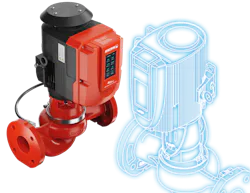
In HVAC applications, a digital twin is a live digital representation of a physical asset or system that uses operating data from real-world conditions and compares it with expected performance. Applied well, it can reveal not only how a pump, chiller, heat exchanger, cooling tower, or air-handling unit is performing, but also how a building’s entire HVAC subsystem behaves as loads shift in real time.
As sensing, analytics, cloud platforms, and edge controls improve, digital twins are becoming a more realistic way to close the gap between design intent and day-to-day operation.
It also helps to think about digital twins at more than one scale. While an equipment-level digital twin may model a single pump or chiller, a system-level digital twin may capture interactions across a loop, plant, or thermal network. Meanwhile, a portfolio-level twin may allow owners to compare performance across multiple buildings or campuses.
That broader view matters because many of the largest HVAC gains come not from one asset operating better in isolation, but from coordinated performance across equipment, systems, and sites working together to deliver comfort.
From Static Design to Dynamic Operation
Traditional HVAC design is still heavily shaped by peak-load assumptions, fixed operating points, and independent control loops for flow, pressure, and temperature. The problem is that most buildings spend far more time at part load than at design conditions.
When systems sized for peak operation spend most of their time in part-load mode, inefficiencies appear as oversizing, unforeseen control disturbances, and excessive cycling, resulting in wasted energy. The Pacific Northwest National Laboratory (PNNL) notes that 10% to 30% of the energy used in commercial buildings is wasted because of improper and inefficient operations.
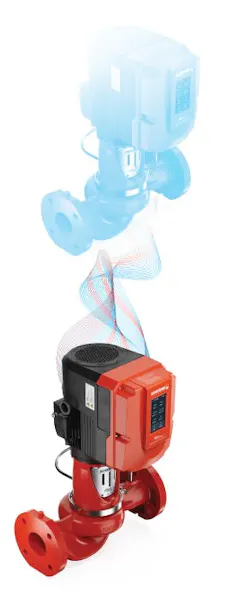
A digital twin addresses that gap by continuously comparing the baseline model with optimal digital twin performance. Instead of relying only on static setpoints, operators can see how systems respond to changing loads, weather, occupancy, and equipment degradation. This shifts operation from reactive control toward predictive, performance-based management.
Creating a Digital Representation
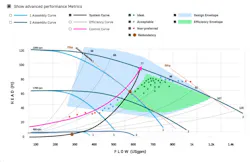
At the equipment level, digital twins are typically built from performance maps that relate variables such as flow, pressure, speed, power, temperature, vibration, and efficiency. Those relationships help define optimal operating ranges, often described as a performance envelope, where equipment performs most efficiently and reliably.
For engineers, that shifts the question from whether equipment is heating or cooling to whether it is running in its most efficient range.
In complex building systems, that distinction matters. One loop may satisfy its setpoint while forcing another component into an unstable or inefficient condition, creating fluctuations, wear, and unnecessary energy use. Digital twins help expose those interactions.
Just as important, digital twins are not simply a monitoring layer. Many early deployments have been effective at visualization, alarming, and simulation, yet still stop short of improving 'live' system behavior. In practice, the real value appears when digital insight is connected to coordinated control execution of complex systems.
For example, this insight can allow pumps, valves, heat exchangers, and chillers to respond as an integrated system rather than as independent devices chasing separate setpoints. Digital twins can help HVAC engineers shift the discussion from visibility alone to coordinated physical behavior under changing conditions.
Energy Optimization
Of course, HVAC energy efficiency serves as a primary driver of interest in digital twins. According to the UNEP Global Status Report, approximately 37% of global CO2 emissions come from buildings. The International Energy Agency also reports that buildings account for around 30% of global energy demand. So even modest gains in plant efficiency can therefore have a meaningful operating impact.
Digital twins improve efficiency by comparing actual performance with expected performance and identifying when equipment is drifting from its optimal efficiency zone. They also support adaptive staging and sequencing, allowing complex building subsystems to operate in more efficient system-level orchestrations as demand changes.
That is especially important at part load, where many traditional systems rapidly lose efficiency. In central plants, the benefit is not only better performance from individual assets, but better coordination across the entire plant.
Supporting Predictive Maintenance
Maintenance strategy is changing as digital twins mature. Instead of relying only on reactive repairs or calendar-based maintenance, operators can use a digital model to compare expected and actual behavior and identify subtle deviations that may point to developing problems before they lead to failure, including:
- Increasing vibration;
- Unusual temperatures;
- Flow instability;
- Efficiency drift;
- Abnormal cycling.
This allows maintenance teams to intervene sooner and to help prevent catastrophic failures and costly repairs.
For multi-site owners, the value can extend beyond one facility.
Connecting twins across a portfolio creates opportunities for cross-site benchmarking, standardized performance verification, and faster identification of recurring issues. A plant underperforming in one building can be compared with similar systems elsewhere, helping teams distinguish a local operating problem from a broader design or maintenance pattern.
Over time, that kind of lifecycle verification can support retro-commissioning, capital planning, and long-term asset management with data-driven evidence.
Overcoming Oversizing
Digital twins are also influencing design. HVAC systems have traditionally been oversized to compensate for uncertainty, but better operating data allows engineers to design around validated performance ranges rather than broad safety margins.
That can support more flexible plant architecture, better turndown, lower installed horsepower, and faster commissioning and performance verification. In that sense, the digital twin is becoming not just an operations tool, but a feedback loop between design, commissioning, and lifecycle operations.
Artificial Intelligence and Advanced Supervisory Control
Today, manufacturers are increasingly layering artificial intelligence (AI) onto digital twin platforms to strengthen prediction and control. In advanced HVAC applications, AI can analyze historical trends, weather, occupancy, and real-time telemetry to anticipate demand and support better staging, flow, and temperature decisions before conditions drift out of range.
That supervisory layer can reduce the common hunting and constant seasonal tuning found in reactive proportional-integral-derivative (PID) based operation and improve coordination across hydronic and air-side subsystems.
Increasingly, that coordination is moving closer to the equipment through edge-based architecture. In a hydronic plant, a load change in one part of the system may require a near-immediate response across pumps, heat exchangers, and central plant equipment.
A digital twin can support that response by maintaining an updated picture of the operating state and informing more synchronized control actions. This is particularly relevant in district energy systems, healthcare facilities, and data centers, where stable thermal performance depends on managing interactions across the entire cooling or heating chain.
Even so, successful deployment still depends on sound engineering fundamentals: accurate equipment models, reliable sensor data, proper commissioning, and validated control sequences.
Challenges to Adoption
Adoption, however, is not without obstacles. Many existing buildings still lack the sensing, connectivity, and control integration needed to support robust digital twin applications. Data quality, cybersecurity, interoperability with legacy systems, and limited in-house expertise remain practical barriers.
That means adoption is likely to happen first in larger institutional, healthcare, higher education, industrial, and mission-critical facilities where operating complexity and energy intensity justify the effort.
A More Intelligent Operational Future
For HVAC engineers, the growing importance of digital twins is not simply about adding another layer of software. It is about creating a better operational bridge between design intent and real-building efficiency impact for the end customer.
By combining live data, performance mapping, coordinated control, and portfolio-level learning, digital twins can help improve efficiency, reliability, commissioning, and lifecycle decision-making. In an industry facing rising energy costs, tighter carbon targets, and more demanding operating conditions and constraints, they are emerging as one of the more important tools shaping the next generation of high-performance intelligent buildings.
####
Kevin Laidler is the Global Director, Consultant and Specifications, at Armstrong Fluid Technology. He has played a key role in advancing HVAC technologies and supporting complex engineering projects throughout his career.