Transforming Science into Healthier Buildings
Key Highlights
- Global Commission on Healthy Indoor Air aims to make healthy IAQ a standard through a comprehensive framework organized around nine market transformation levers;
- New report makes nearly 180 recommendations for action across 40 strategic focus areas;
- Engineers and building professionals play a vital role in translating health science into practical design, operation, and policy, fostering continuous improvement in IAQ;
- Market recognition of the value of healthy indoor air is essential; demonstrating benefits like reduced absenteeism and improved cognitive performance can drive change;
- Local strategies and blueprints are crucial for adapting global frameworks to specific contexts, ensuring effective implementation and sustained impact.
By JASON HARTKE, PhD, Executive VP, International WELL Building Institute
“Indoor air is not passive. It is a delivery system.”
When Rachel Hodgdon of the International WELL Building Institute (IWBI) delivered that line earlier this year in a keynote to the International Society of Indoor Air Quality and Climate (ISIAQ), she named something every building engineer and practitioner understands but others often miss – every building shapes the air its occupants breathe, whether by design or by default.
Sometimes that air is clean, healthy and carefully managed. Other times, without notice or measurement, it carries fine particles, pathogens, combustion byproducts, volatile organic compounds, allergens, infectious aerosols or wildfire smoke. According to the EPA, indoor air is, on average, two to three times more polluted than outdoor air.
Occupants may not see or feel the difference, but their lungs certainly do.
As Hodgdon went on to say, “Too often, [the building] is delivering things our bodies were never meant to breathe. We are taking them in quietly, constantly, unknowingly – with every breath. And over time, sometimes slowly and sometimes suddenly, they degrade our health, weaken our lungs, dull our focus, strain our immune systems and contribute to this staggering burden of disease and even premature death.”
The Second Wave of Sustainability
The average person takes about 20,000 breaths a day. In the U.S., most of them happen indoors where people spend 90% of their lives. Homes, offices, schools, hospitals, airports and all indoor spaces sit at the boundary between outdoor conditions, indoor sources and the air ultimately drawn into our lungs.
The building sector has made considerable progress reducing energy use and operating costs through efficiency and sustainable design. Yet it remains in the early stages of realizing the comparable potential of healthier indoor air, and capturing the health, performance and resilience benefits that come with it.
Rick Fedrizzi, one of the principal founders of the green building movement, a longtime CEO of the U.S. Green Building Council (USGBC) and the current executive chairman of IWBI, recognized that turn toward human health a decade ago. “We are witnessing the ‘second wave of sustainability’ when it comes to the built environment.”
“The First Wave was all about protection and minimization,” he said in an article in 2017, describing sustainability’s initial emphasis on reducing the built environment’s burden on the planet. “But what we’re beginning to understand—and what the Second Wave is all about—is the potential for buildings to actively promote health and well-being.”
Indoor air should be central to that second wave. Instead, it remains largely underrecognized and undervalued, in part because the problem, like the air itself, is invisible. Out of sight has too often meant out of mind.
That invisibility carries a steep cost.
Air pollution contributed to 7.9 million deaths worldwide in 2023, according to the State of Global Air, and household air pollution alone is associated with nearly 3 million premature deaths each year. Indoors, the hazards are both familiar and evolving: fine particles, combustion byproducts, volatile organic compounds, dampness and mold, allergens, infectious aerosols and wildfire smoke – all of which finds its way into our buildings.
Nor is burden evenly shared.
Children, older adults, people with chronic disease and communities with fewer resources often face the greatest risks and the fewest protections. Dr. Yele Aluko, health industry strategist at the Harvard Business Review and former chief medical officer at EY and co-chair of the Commission, makes the equity stakes explicit. “The impacts of polluted indoor air—worsened by wildfires and climate change—are not felt equally,” he says. “Vulnerable communities, especially children, bear the heaviest burden. Poor air quality doesn’t just reduce performance; it harms health, development, and opportunity.”
The question, then, is no longer whether indoor air shapes health, learning, cognition, productivity and resilience. The evidence is clear. The harder question is how to turn decades of science and a growing toolbox of solutions into a coordinated strategy capable of transforming buildings at scale.
How a Global Commission Took on a Public Health Crisis
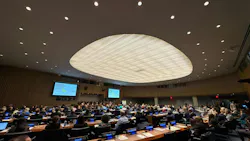
That challenge brought a uniquely distinguished group to the United Nations last September during Climate Week. Scientists and doctors sat alongside engineers, architects, public health leaders, advocates, real estate executives, manufacturers and investors to launch the Global Commission on Healthy Indoor Air. Its mission was ambitious in its simplicity: make healthy indoor air the norm not the exception.
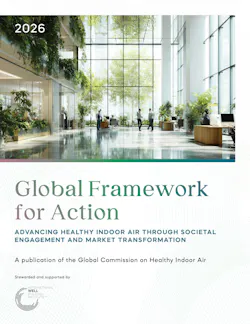
- To download the new report, click here.
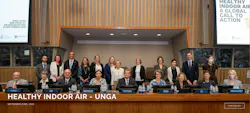
Today, the Commission includes more than 200 leaders and experts from more than 40 countries, among them some of the world’s most distinguished scientists, public health luminaries, technical experts, building practitioners, business leaders and advocates helping advance healthy indoor air.
“The Commission’s long-term vision is a future in which healthy indoor air is expected, measured, valued, financed, governed and continuously improved across the places where people live, learn, work and heal. In short, healthy indoor air should be the norm, not the exception.” —Global Framework for Action
Announcing the formation of the Commission, Hodgdon invoked Margaret Mead's familiar quote about the ability of thoughtful, committed people to change the world. She then made the challenge specific to indoor air, saying, "When we come together with purpose, when we collaborate across boundaries, we can create amazing change. We can reshape markets. We can transform systems. And most importantly, we can improve lives."

The full meaning of that collaborative moment served as a sign of things to come.
Indoor air measures had made strides in the preceding decades, but the agenda had advanced intermittently, and largely within the separate lanes of individual disciplines or fields. In building practice, meanwhile, it had until recently been seen as a nice-to-have. The message sent by this multidisciplinary group coming together under the umbrella of the Commission, while implied, was loud enough: no single stakeholder group, agency, standard, technology or funding source would be able to deliver healthy indoor air at scale alone.
For Hodgdon, the gathering captured both the significance of the moment and the scale of the opportunity.
“Gathered there in the United Nations, we knew it was a special moment, a chance to put indoor air on the global agenda,” she said. “By working together and delivering a transdisciplinary strategy, the Commission set out to develop a signature deliverable by drafting the first-of-its-kind framework to ignite the movement, inform decision-makers, accelerate innovation, unlock new sources of funding, shape policy and raise public awareness.”
From Momentum to a Roadmap
On September 22, the Commission returned to New York during Climate Week to launch the Global Framework for Action: Advancing Healthy Indoor Air through Societal Engagement and Market Transformation. In the words of the Commission's co-chairs, it is not simply a report but a shared strategic roadmap, uniquely designed to translate global momentum around healthy indoor air into market transformation.
That distinction is important. The Framework does not prescribe a ventilation rate, a sensors and controls methodology, a filtration strategy or a policy model. Buildings, climates, resources, governance structures and public-health burdens vary too widely. Instead, it identifies the universal levers that can elevate healthy indoor air as a public health imperative and market priority, and ultimately institutionalize it as an everyday expectation in buildings everywhere.
“It’s made up of a series of strategic focus areas and recommendations, but it’s organized around the major pillars of market transformation. In effect, it gives us, and the entire global community that cares about this issue, a much-needed game plan,” said Fedrizzi.
In the Framework’s foreword, he continued, “That’s a big deal. When I was helping grow energy efficiency and green building years ago, we didn’t have a playbook like this. We were writing it as we went along. This time, we have taken the time to develop and coalesce around the right playbook. And in market transformation, preparation saves time, saves resources and can serve as a powerful accelerant. In other words, the better the plan, the faster the market can move.”
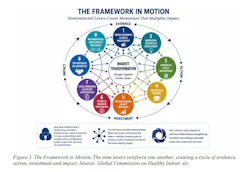
Nine Levers Working as One
The Framework organizes around 40 strategic focus areas and nearly 180 recommendations across nine interrelated and interconnected levers of market transformation:
- Building awareness and public engagement;
- Innovation, research and development;
- Advocacy and policy development;
- Education and training;
- Demand and market incentives;
- Financing and resource mobilization;
- Codes, standards and leadership certifications;
- Partnerships and collaboration;
- Implementation, monitoring and evaluation.
The list is less important than the relationships among its parts. Research strengthens the evidence and fuels innovation. Training moves that evidence into design and operations. Better technologies improve measurement and controls while lowering costs. Innovative financing determines whether these solutions reach more buildings. Policy establishes expectations and strengthens accountability. Standards, workforce capacity and implementation turn those expectations into real-world performance. Awareness keeps demand high, while visible results build trust, and trust attracts new investment.
Together, the Nine levers of the Framework can create a flywheel of market transformation, with progress in one generating momentum across the others.
That systems view may be the Framework's most consequential contribution. Healthy indoor air has not stalled for lack of evidence or solutions.
Ventilation, filtration, source control, moisture management, material selection, monitoring, commissioning and sound operations are all well established. Progress stalls when those solutions remain disconnected from the policies, budgets, incentives, workforce and accountability structures needed to sustain them.
“Healthy indoor air is far more than a building issue. Ensuring that everyone can breathe healthy indoor air is a sacred responsibility, one that influences health, opportunity and resilience throughout life,” said Dr. Richard Carmona, 17th Surgeon General of the United States and Co-Chair of the Global Commission on Healthy Indoor Air. “This Framework brings public health and the building sector to the same table, uniting us behind a common vision and giving us a shared plan of action to protect people in every community."
Engineer as Translator and Integrator
For engineers, the Framework is both validation and a challenge. It recognizes that technical competence remains indispensable, but the work extends beyond the traditional boundaries of building systems. Engineers and other stakeholders must help translate health evidence into design intent, explain risk to owners, coordinate with public health experts, test and validate operational performance and help decision-makers understand the consequences of value-engineering health out of a project. The engineering community was already moving in this direction before the Commission launched.
“After the pandemic, I saw attention to IAQ slipping and old habits returning,” said Bill McQuade, global vice president and head of government affairs and sustainability at Baltimore Air Coil and the immediate past president of ASHRAE, who made the theme of his presidency indoor environmental health. “As President, I wanted ASHRAE to refocus the industry on occupant health, wellness and productivity — not just building performance.”

That agenda produced an enduring institutional home to advance that work. “We launched the permanent Center of Excellence for Indoor Environmental Quality, which now carries that mission forward through education, guidance, standards, research, and global leadership,” said McQuade, who also serves as a Commissioner.
This translation and integration role is especially important in practice. Outdoor conditions change. Occupancy changes. Filters load. Controls drift. Spaces are repurposed. Maintenance budgets tighten. A health-based approach therefore depends on feedback: commissioning, assessment, monitoring where appropriate, clear indicators and continuous improvement.
“Managing indoor air quality for health could become one of the defining breakthroughs of modern healthcare, turning buildings into active tools for disease prevention and improved human performance. The benefits of fewer illnesses, lower healthcare costs, stronger schools and workplaces, and healthier communities reach across society,” says Stephanie Taylor, MD, chief medical officer at ThinkLite Air, underscoring the urgency to act. “Engineers can lead this transformation by setting health-centered performance targets, challenging outdated assumptions, demanding measurable outcomes, and making healthy indoor air a non-negotiable standard wherever people live, learn, and work. Who can say ‘no’ to this?”
As Taylor notes, codes and standards also remain essential to that process. They can raise the floor, establish common language and give owners confidence that health-focused performance is achievable.
“Ten or 15 years ago, many IAQ researchers, especially those in academia, seemed uninterested or even averse to contributing to policy and standards. As a direct outcome of the COVID-19 pandemic, that community is now aggressively working to move the results of science into practice,” said Bill Bahnfleth, professor of architectural engineering at Penn State, Global Commissioner and member of ASHRAE’s Center for Excellence on Indoor Environmental Quality. “To accelerate market change, the focus needs to be on putting affordable, safe, and effective technologies into existing buildings. In-operation requirements that are currently lacking combined with education and incentives are keys to doing that.”
Building on that ethos, the Framework also calls for implementation pathways and accountability mechanisms that make performance visible in practice, not merely compliant at the moment of design. Leadership certifications, too, have an important role to play, helping set higher leadership thresholds, demonstrate demand, uphold accountability, create models that support wider adoption and inspire the market.
The work also requires integration across the sustainability spectrum. Indoor air cannot be separated from energy, decarbonization, thermal comfort, acoustics, lighting or resilience. The Framework flatly rejects the premise that health and climate are competing objectives. It instead calls for integrated strategies that reduce risk, support human performance and advance leading sustainability practices in new and existing buildings.

Making Health Visible in the Market
In the end, progress will scale only when the market recognizes the real and full value of healthy indoor air. The Framework identifies value creation as a core principle because building decisions are made in budget meetings as surely as they are made in mechanical rooms. Showing how healthier spaces can reduce risk and absenteeism, support cognitive performance and learning, strengthen resilience and create organizational value can change what owners, lenders, insurers, employers, school systems and governments choose to specify, fund and maintain.
“Our health is inextricably tied to the health of our buildings - our homes, our schools, the places we work,” said Dr. Joseph G. Allen, Associate Professor, Director of Harvard’s Healthy Building Program at Harvard T.H. Chan School of Public Health, and author of the bestselling book Healthy Buildings. “Buildings represent one of the most powerful tools we have for improving the human condition globally."
Creating and demonstrating that intrinsic value also depends on trust. People cannot value what they cannot see or act on information they do not understand. That is why the Framework connects public engagement with credible measurement, disclosure and accountability.
Global Foundation, Local Pathways
Of course, the Framework as a global roadmap is not a substitute for locally driven strategies, nor was it designed to be. In fact, a key part of the Commission’s continuing work is to support the development of country-specific Blueprints for Action, customized to local context, governance, climate, building stock, resources and institutional readiness.
The Global Framework can serve as the strategic foundation for these nationally-tailored blueprints, which can utilize the nine levers across each country’s priorities, implementation pathways, financing strategies and stakeholder responsibilities. Engineers will be essential to that work, sharing their knowledge and understanding of the building stock, infrastructure constraints, climate conditions and operating realities.
From Plan to Practice
Moving forward, the Framework’s strength lies in how we all use it to influence a design brief, a capital plan, a curriculum, a procurement requirement, a building code, a maintenance practice or a public expectation. Its nearly 180 recommendations are not a scorecard for completing everything at once. They are a menu of coordinated moves that governments, businesses, professional associations, researchers, financial institutions and communities can adapt to their own points of leverage.
As Fedrizzi summarized the Commission’s purpose, “At its core, the work of the Global Commission is about people–their health, their safety and their ability to thrive in the indoor spaces where we live our lives.”
The Framework’s ultimate test is whether it improves the quality of the indoor air people breathe. Every day, human lungs will keep drawing air inside our buildings, thousands of times a day. The task now is to make those breaths healthier – by design, not default.
####