ASHRAE: The Current State of HVACR
From the AHR 2027 Trend Report
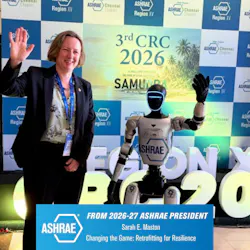
By SARAH E. MASTON, PE, BCxP, LEED AP, ASHRAE President, 2026-2027
The HVACR industry is at an important inflection point.
We are no longer simply asking how we can make individual systems more efficient; we are asking how those systems can work together to make entire buildings perform better, remain resilient and deliver greater value over their lifetimes. That shift is changing the way we approach everything from retrofits and commissioning to controls, refrigerants, heat pumps and indoor environmental quality.
The opportunity ahead is significant, but it will require a clear game plan and people across the industry working together to put that plan into action.
INDUSTRY SHIFTS AND CHANGES
The industry is becoming much more focused on the performance of the building as a whole rather than treating individual systems and components in isolation. We are seeing greater integration among HVAC, controls, electrical systems, water systems, building automation and the grid. At the same time, technologies such as AI, heat pumps, advanced controls and digital twins are changing what is possible.
Perhaps the most significant shift, however, is the growing recognition that the existing building stock represents an enormous opportunity. We don’t have to wait for new construction to make meaningful progress. We can improve the buildings we already have and do so in ways that make them more efficient, adaptable and resilient for the future.
We are also seeing a shift in how the HVACR profession itself must evolve. That means technical expertise remains essential, but professionals increasingly need to understand controls, data, cybersecurity, grid interaction, water resources and building operations.
For ASHRAE, that reinforces the importance of standards, guidance, education and professional development that help people navigate this changing environment. We need to make sure the workforce has both the foundational knowledge and the new skills needed to take advantage of emerging technologies and address increasingly complex building challenges.
TRENDS LIKELY TO HAVE GREATEST IMPACT
Some of the most active member conversations are centered around building decarbonization, energy efficiency and retrofits, resilience, heat pumps, IEQ, advanced controls and the responsible application of AI. Data centers and mission critical facilities continue to generate significant interest as computing demands increase and cooling, power and water requirements become more complex.
We are also seeing considerable attention on refrigerant transitions, predictive maintenance, digital commissioning, building performance verification and workforce development. What connects many of these conversations is the need to understand how solutions perform as part of an integrated building system.
OVERALL OUTLOOK
The outlook for next year is strong, although it will not be uniform across every market or application. Demand for building modernization, high-performance systems and mission-critical facilities is creating significant opportunities for HVACR professionals.
At the same time, the industry is navigating significant change. Owners are balancing investment decisions against costs, workforce availability, infrastructure limitations and increasingly sophisticated technology. The professionals who can help them evaluate those factors and develop practical, phased strategies will be particularly valuable.
MOST PROMISING OPPORTUNITIES
One of the greatest opportunities is the existing building stock. There is enormous potential to improve buildings that are already occupied and operating, rather than waiting for new construction. That creates demand for professionals who can assess existing conditions, identify the highest-value improvements, develop a realistic implementation strategy and verify performance.
The biggest opportunity is to expand our definition of what HVACR and plumbing systems can contribute to a building. Energy and water efficiency, IAQ, resilience, decarbonization and occupant health are increasingly interconnected.
As I noted, existing buildings offer an especially significant opportunity. Retrofits can improve performance while extending the useful life of buildings, reducing operating costs and preparing facilities for changing conditions.
Data centers and other mission-critical facilities also represent rapidly evolving markets where HVACR and plumbing expertise will be essential to addressing cooling, heat rejection, water use and reliability.
The professionals who can connect these challenges and work across traditional disciplines will be in a particularly strong position.
CHALLENGES AND HEADWINDS
Many of the industry’s challenges are interconnected. Again, workforce availability, project costs, access to capital, refrigerant transitions, grid capacity and aging infrastructure can all affect how quickly improvements can be made.
Another challenge is managing the increasing complexity of building systems. As buildings become more connected and technology advances, we need professionals who understand not only how individual systems work, but how they interact. We also need to make sure that new technologies are properly designed, installed, commissioned, operated and maintained so that their potential translates into actual performance.
THE VALUE OF AHR EXPO
Our members are asking very practical questions: How do we retrofit an existing building without disrupting operations? How do we know which improvements will provide the greatest value? How do we integrate AI and advanced controls responsibly? How do we manage new refrigerants safely? How do we address higher-density cooling and power demands? How do we verify that a system is actually performing as intended?
Those questions should translate directly to the show floor in Chicago. Attendees will be looking for technologies that solve real problems, but they will also be looking for integration, compatibility, serviceability, training and the expertise needed to implement those solutions successfully.
The value of AHR Expo is that it brings those pieces together. It gives professionals an opportunity to see what is changing, compare approaches and connect with the people who can help turn an idea into an operating system.
AI IN OUR SECTOR
AI is creating the greatest value where it helps professionals make better decisions with the data buildings are already generating. That includes predictive maintenance, fault detection and diagnostics, building automation, energy optimization, load forecasting and operational decision-making.
The opportunity is not to replace the expertise of engineers, technicians or building operators – they cannot be replaced. It is to give those professionals better information and help them identify problems and opportunities more quickly.
AI can help a building team understand what is happening, determine where attention is needed and evaluate potential responses. There are also important considerations around data quality, cybersecurity, interoperability, transparency and human oversight. AI will be most valuable when it is integrated into a broader building strategy rather than treated as a stand-alone solution.
There is enormous potential in AI, but the important question is how we turn that potential into better decisions, better performance and more reliable operations while maintaining appropriate human oversight.
LOOKING AHEAD TO CHICAGO
I expect attendees at our Winter Conference and AHR Expo to prioritize solutions that improve performance while addressing the realities of existing buildings. That includes high-efficiency equipment, heat pumps, advanced controls, building automation, predictive maintenance, IAQ technologies, refrigerant solutions and tools for commissioning and performance verification.
Existing buildings represent an enormous opportunity, but owners need
practical pathways from assessment to implementation. I want to see more solutions that help address cost, disruption, phasing and operational constraints while delivering measurable improvements.
Data centers will continue to be a major focus, particularly liquid cooling, heat rejection, water efficiency, grid interaction and strategies for adapting existing facilities to higher-density computing.
I also expect a strong emphasis on workforce solutions. As systems become more sophisticated, the industry needs people who can install, commission, operate and maintain them. Technology and talent have to advance together.
Technology is changing quickly, and so are the demands being placed on buildings. We need to make sure our workforce, standards, education and practices are keeping pace. The strongest solutions will come from people with different perspectives developing and executing the game plan together.
#####
For more industry insights, and the rest of the AHR 2027 Trend Report, please click here.